


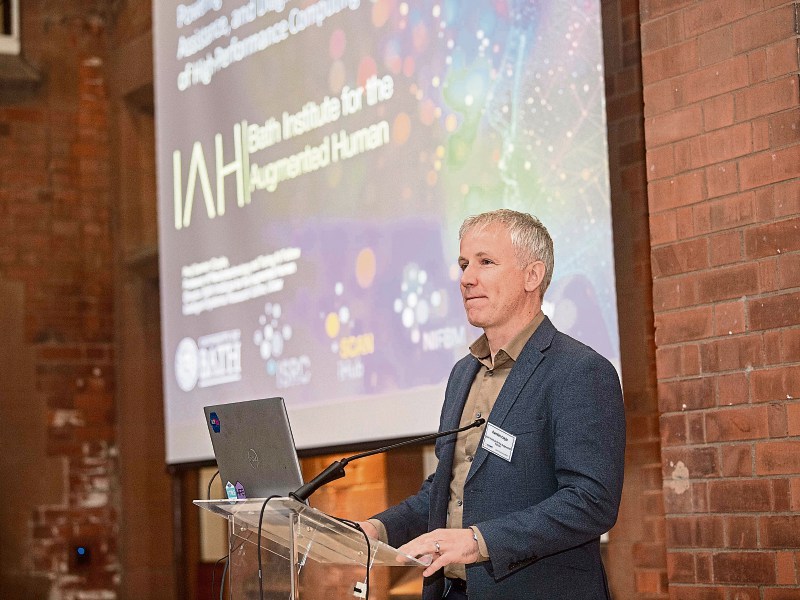


A LETTERKENNY man who once sat in classrooms at Errigal College is now at the forefront of neurotechnology research and credits the north west for providing the foundation that shaped his career.
Professor Damien Coyle from Correnagh, Letterkenny is now a Professor of Neurotechnology at the University of Bath and director of the Bath Institute for the Augmented Human.
He is also the founder of NeuroCONCISE, a company developing innovative, accessible brain-computer interface technology.
A son of Cllr Donal and Kathleen Coyle, Dr Coyle’s work involves developing systems that measure brain activity and translate it into signals that allow people to interact with technology or support recovery from cognitive or physical disabilities.
One of Dr Coyle’s most significant research projects focuses on helping people with severe brain injuries, including patients emerging from comas.
Dr Coyle and his team recently completed a major study involving over 40 participants across 17 hospitals in the UK and Ireland.
“We put headsets on these people and we ask them to imagine movement and determine if there is a response there that would be expected when a person imagines movement.
“If we do see that response then we’ve got an indication that the person has awareness and may have some residual brain activity or some cognition.
“Once we establish that we enter them into a programme of learning to modulate their own brain activity, that’s followed by a closed question and answer system where we evaluate their response and they are categorised into different type of awareness.”
This work has the potential to significantly improve diagnosis and treatment.
He explained that in the future more accurate systems could help patients communicate basic yesno responses, shaping safer and more personalised care pathways.
The same technology is also being applied to stroke rehabilitation, helping patients regain function by imagining movement to trigger activity in the motor cortex.
It has also helped people suffering from PTSD.
At the University of Bath, the neurotechnology researchers work alongside experts in augmented and virtual reality, prosthetics, robotics, exoskeletons and wearable devices.
Together, they aim to enhance human performance across health, sport and other fields.
“These technologies are not easy to develop but beyond healthcare application they may give humans a performance enhancement.”
Alongside applications in cognitive and physical rehabilitation, the technology also opens the door to new forms of entertainment through neurogaming.
Dr Coyle’s achievements recently gained international attention when The New York Times highlighted the story of Owen Collumb, who was paralysed in 1993 at the age of 21 after a spinal cord injury.
A native of Longford, Mr Collumb attended Atlantic Technological University in Letterkenny in the 90s and now lives in Dublin.
He uses a full scalp cap with more than 30 electrodes, which allows him to control computers with his mind. He uses the amazing brain-computer interface technology to compete in the Cybathlon competition which offers a platform to advance research in the field of assistive technology, promote greater inclusion for people with disabilities and enables people like Owen to compete globally.
Through NeuroCONCISE, Dr Coyle and his team are developing neurotechnology which is designed to be more wearable, affordable and easy to use.
“The idea is that it is more accessible or portable, and it doesn’t look too unusual when you’re wearing it.
“It can be opened out of the box and used in the home without too much complexity,” he said.
Dr Coyle, who now lives at Tara Court in Letterkenny, sees enormous potential for the future.
In the next five to ten years, he expects these technologies to become far more common, providing non-drug interventions for conditions where medication may cause side effects and offering accessible support for people with disabilities.
However, he also emphasised the importance of strong governance, ethics and social responsibility as these tools become more powerful and widespread.
A past student of Errigal College, Dr Coyle chose the school due to his early interest in engineering.
He later studied computing and electronics engineering at Ulster University’s Magee campus, continuing on to a PhD before rising to professor and director of the Intelligent Systems Research Centre at Ulster, before taking up his current position at the University of Bath.
Though now leading cutting-edge international research, Dr Coyle remains firmly connected to the region that shaped him – a region he believes is fast becoming one of the Ireland’s strongest centres for technology and AI innovation.
He spoke of the strong cross border collaboration especially between Atlantic Technological University and Ulster University.
Both are members of the North West Tertiary Education Cluster (NWTEC) a strategic alliance of the four publicly funded education institutions in the north west, including Atlantic Technological University, Ulster University, North West Regional College and Donegal Education and Training Board.