


By Paul Bradley
In Ireland, and perhaps particularly in the north west, we tend to think of World War II as somewhat remote, something that didn’t affect us too much.
But we did have rationing, and blackouts, and we did need to take measures to make sure we weren’t bombed accidentally; and we had occasional military planes crashing into the county, and much of the Battle Of The Atlantic happened within sight of our coastline.
And there were other connections, if not so widely known. By the mid-1930s, Donegal had drawn the attention of Nazi Germany’s intelligence apparatus: the county appealed to them as a possible backdoor into Britain.
Of Donegal’s Nazi links, the most striking is Professor Ludwig Mühlhausen, a professor of Celtic Studies at Berlin University who, in the summer of 1937, spent six weeks in Teelin claiming to be collecting folklore and perfecting his Irish.
Indeed, he did spend time talking to the locals (despite being sneery about them, complaining that they “lacked German efficiency”), recording stories from traditional storytellers (he translated a number into German, which he later sent to Taoiseach Éamon de Valera).
But Mühlhausen was also a committed member of both the Nazi Party and the SS, and his behaviour was instantly suspicious: one of his first acts in Teelin was to hang a photo of Hitler in his rented bedroom.
He roamed the countryside taking photos and was seen repeatedly dropping lead weights into the waters of Teelin Bay: measuring the depths as a potential landing site for German U-boats.
Irish military intelligence monitored him and compiled a file in which they described him as “an enthusiastic Nazi.” A few years ago, in the Bundesarchiv (Federal Archives) in Berlin, BBC journalist Kevin Magee found Mühlhausen’s photos from Teelin in what was effectively a handbook for a Nazi invasion of Ireland.
Mühlhausen left after six weeks, but his Irish was strong enough that he became a kind of Irish-language Lord Haw-Haw, broadcasting in Irish from a radio station in Berlin, urging Irish listeners to maintain their neutrality.
He was decorated personally by Himmler for his services to the Nazi regime, but was sent to a prisoner of war camp in Naples in 1945; from there he wrote (in Irish) to President Hyde appealing for help. There is no evidence that Hyde ever replied, and Mühlhausen died in Ulm in 1956.
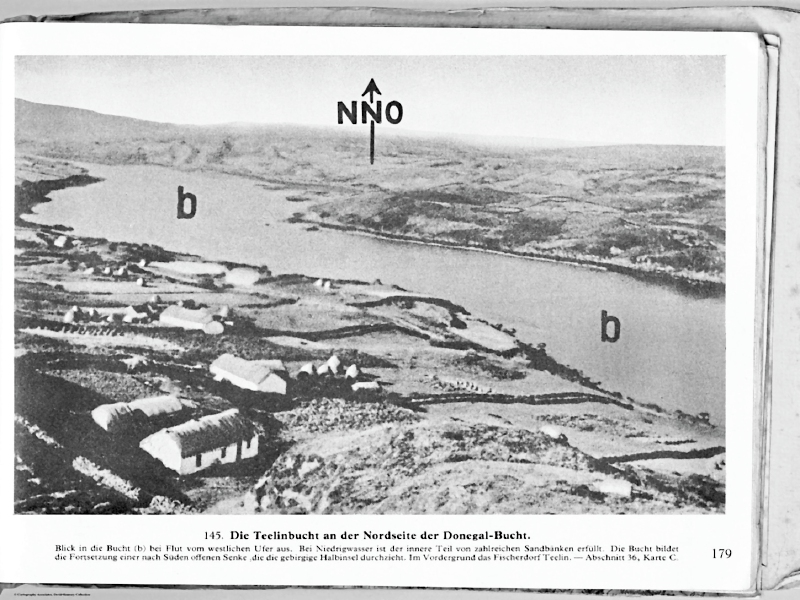
A Nazi shot of Teelin.
A significant figure who worked with Mühlhausen was Dr Adolf Mahr, an Austrian archaeologist appointed Director of the National Museum of Ireland in Dublin in 1933 by Éamon de Valera — a position he could use to provide Germany with detailed knowledge of Irish geography, infrastructure, and public sentiment.
Mahr had joined the Nazi Party in 1933 and by 1934 had become the head of its Irish chapter, earning the nickname “Dublin Nazi No. 1.”
Mahr had done fieldwork in Donegal in the 1920s and 1930s, investigating prehistoric sites and finds from Donegal; it was under his direction that the National Museum of Ireland acquired and catalogued material from the county (earning him another nickname, “the father of Irish archaeology”).
Mühlhausen visited him at his Dublin home, and the two men’s activities overlapped considerably. When war broke out, Mahr returned to Germany and never returned, eventually becoming director of the Irland-Redaktion propaganda broadcasts. He was arrested by the British in 1946 on suspicion of having used his museum role to help plan the invasion of Ireland, though no charges were brought.
In the late 1930s, the Abwehr — Nazi Germany’s military intelligence — was exploring every avenue to weaken Britain, and that included Ireland.
A series of clandestine meetings took place between German officials and IRA officers, at least one of which was held in Donegal. Among those present was Eduard Hempel (official title, Envoy Extraordinary and Minister Plenipotentiary), and three members of the Nazi Party. The meeting was reportedly arranged with the involvement of General Eoin O’Duffy, the former Garda Commissioner who had led the Blueshirts, Ireland’s own flirtation with fascism.
For the IRA, the logic was simple: a German victory over Britain offered the best hope of ending partition and achieving a united Ireland.
The Abwehr, meanwhile, saw the IRA as a way of destabilising Britain’s western flank and distracting it from the European war. Their agent Hermann Görtz parachuted into Meath in May 1940, although he’d been aiming for Tyrone – the first of several alternatively sinister and farcical escapades he had around Ireland in his 18 months at large in the country (embarrassing Irish authorities).
It’s not clear how much time he spent in Donegal, but his plans very much involved using it as a staging ground against Britain.
The (ultimately futile) collaboration between the Abwehr and the IRA included “Plan Kathleen”, which proposed a German seaborne landing at Lough Swilly, and a parachute drop near Belfast, with IRA forces rising simultaneously.
The plan was delivered to Berlin in 1940, but was deemed impractical; when Abwehr intelligence officers (including Görtz) analysed the document, they were appalled by its lack of military realism, and lost faith in the IRA. Görtz remarked that the plan was “…completely useless. It nearly broke my heart, since it came from the IRA Chief of Staff.”
There was also a separate plan called Operation Green, drafted in August 1940, which was a German plan to invade Ireland in support of the broader plan to invade Britain (Operation Sea Lion).
Thirty-two top-secret copies were distributed to the German High Command. Donegal featured prominently: among the potential landing zones listed were Donegal Bay, Killala, Ballina, Sligo, Lough Foyle, and several southern ports.
Nowadays Operation Green is seen as more of a diversion than a genuine invasion blueprint; by 1942 it had been passed to Irish military intelligence, which does suggest it was never going to happen.
But the threat was taken seriously by both London and Dublin, and certainly there were Wehrmacht flights over Ireland, and German agents on the ground, taking photos of the country.
British planners took note of Donegal specifically: the British 61st Division, based in Northern Ireland, was set to cross the border into Donegal to seize Lough Swilly for the Royal Navy in the event of a German landing.