


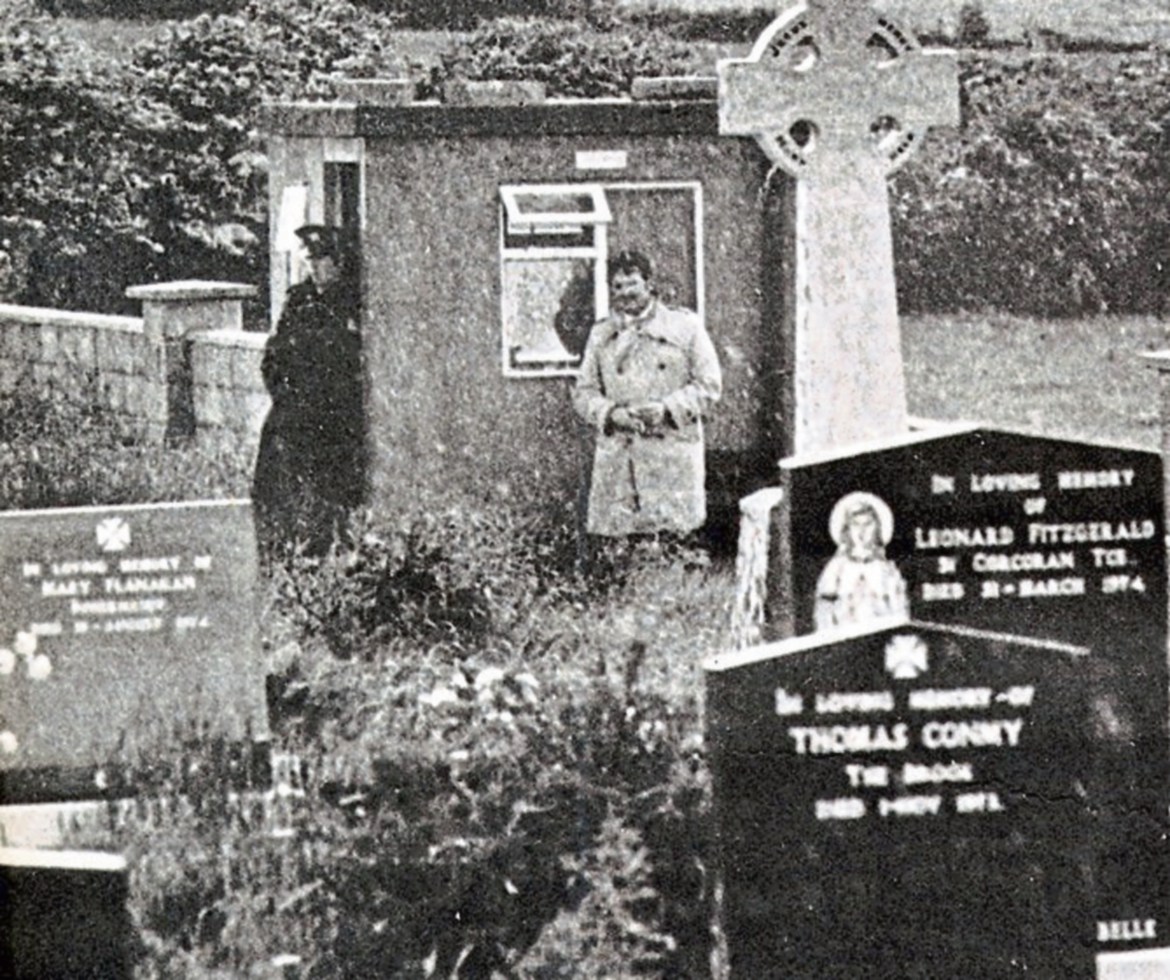


A MAJOR new theatrical production about Frank Stagg, the Mayo hunger striker who died in a British prison in 1976 and whose body was hijacked by the Irish government and buried in an isolated grave against the wishes of his family, is coming to Letterkenny.
‘We have him back!’ will take to the stage at An Grianán Theatre on Saturday, September 5.
The two-act play – which has been performed before sold-out audiences across Ireland – offers an historically accurate and deeply moving account of the events surrounding the “three funerals” of Frank Stagg.
It tells the story of a mother watching her son die on hunger strike, a grieving wife confronting official falsehoods and a brother whose fierce love and iron resolve would not permit Frank Stagg’s dying wish to remain unfulfilled.
Most of the action takes place in a graveyard, with occasional cutaway scenes to a hunger striker’s cell and the kitchen of Frank Stagg’s mother. The characters and events are real, and the dialogue is grounded in historical truth.
Despite the serious nature of the story, scenes are often punctuated with bursts of humorous banter and moments of poignant emotion. Dramatic tension builds in the second act as George Stagg and his comrades embark upon a daunting mission to honor his brother’s last wishes.
The Stagg family gave its full support and blessing to the theatrical project.
Experiences
George, Frank’s younger brother, lived through the events portrayed in the play, and his personal experiences infuse the script with stark realism and historical veracity.
“This production tells our brother Frank’s story with honesty, dignity and accuracy,” George Stagg said. “It honours not only his sacrifice, but the pain, courage and determination of our family in the face of Frank’s treatment even after his death.”
The saga of Frank Stagg’s prison internment and death — and the sordid events that followed — remains controversial despite the passage of 50 years. The ensuing spectacle following Frank’s death garnered national and international attention.
Frank Stagg was sentenced under an obscure 19th century law to ten years in prison for conspiracy to commit arson following a trial in which little evidence was produced.
He endured four hunger strikes over the course of his imprisonment. He refused to be labeled a criminal. His demands remained the same: no forced labour; an end to solitary confinement; access to educational resources; and repatriation to an Irish prison to serve out his sentence.
During his first hunger strike in 1974, Frank was brutally force-fed innumerable times. That strike ended when fellow prisoner Michael Gaughan died from injuries sustained during forced feeding.
After Gaughan’s death, prison authorities banned the future use of the barbaric practice and conceded to the hunger strikers’ demands. Authorities refused, however, to transfer Frank Stagg to a prison in Northern Ireland because he was born in the 26 counties.
When authorities sent him to yet another British prison, the governor there refused to honour the concessions Frank had won.
Frank Stagg died in February, 1976 in Wakefield Prison after 62 days without food. British authorities agreed to return his body to Ireland for burial. But under orders of the Irish government led by Liam Cosgrave of Fine Gael, Frank’s remains were hijacked in mid-flight and flown to Shannon Airport while his aging mother and other family members waited in vain at Dublin Airport for his coffin to arrive. Franks’ body was never returned to the family for burial.
The following day, Frank’s coffin was flown by military helicopter to Our Lady of Sorrows church in Hollymount, County Mayo, for a funeral service monitored by armed guards. His remains were then transported by military convoy to Ballina for internment.
Without permission
The Irish government buried Frank Stagg without permission of the family and against his own dying wishes in a remote grave in Leigue Cemetery. His last will and testament expressed his desire to be buried beside Michael Gaughan in the republican plot.
The Cosgrave government then built a sentry hut manned by two gardaí in close proximity to the grave. When the hut was finally dismantled after 16 months of round-the-clock surveillence, the government ordered four tons of concrete to be dumped upon the grave to ensure that Frank’s coffin could never be removed.
Four months later, on a moonless November night wet with rain, George Stagg and his compatriots embarked upon a daunting mission to ensure that Frank Stagg would finally rest in peace.