


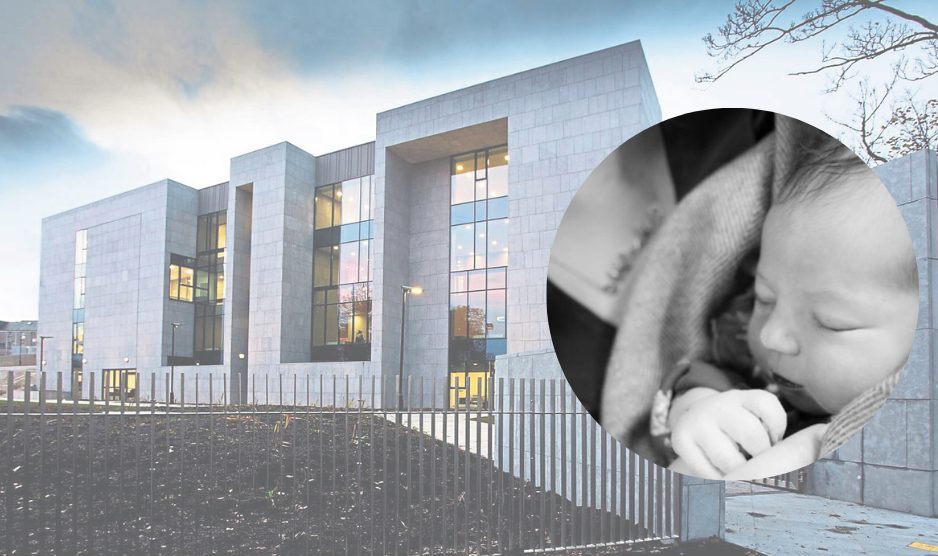


The heartbroken parents of a baby girl who died just one hour after she was born at Letterkenny University Hospital have told of their nightmare and pain at an inquest into her death.
The inquest into the death of baby Bláithín O’Riordan has been taking place in Letterkenny.
Baby Bláithín’s heartbroken parents, Natasha and Liam O’Riordan, were first to give evidence at Tuesday’s sitting of the coroner’s court sitting in Letterkenny Courthouse.
They spoke of the “pure joy” on February 4, 2023 when their beautiful daughter was born at 6.56am, weighing a healthy 7lbs 7oz.
But tragically by 8.02am baby Bláithín was pronounced dead. All of their dreams were shattered.
Natasha who gave her deposition first spoke of her pregnancy, which she described as “perfect”.
The couple had undergone IVF treatment and at the end of May 2022 they were delighted to receive a positive pregnancy test. Her due date was February 1, 2023.
Natasha, a midwife manager at LUH, told the coroner’s court of how her whole pregnancy went smoothly and her scans flagged no concerns.
She had a bout of the cold at 28 weeks, slightly raised blood pressure on a couple of occasions towards the end of her pregnancy that always settled on its own and a bit of swelling in her legs and feet – nothing out of the ordinary.
On February 3, 2023, Natasha was admitted into the antenatal ward due to her elevated blood pressure and a propess pessary was inserted to induce her labour.
All the checks performed on that day were normal and Bláithín’s movements were good.
By 11pm that night, Natasha had begun to have regular contractions. They quickly became intense and caused Natasha to become distressed. She was placed on a CTG monitor and Bláithín’s heart rate was normal.
The obstetric registrar was called and they discussed removing the pessary which was still in place. This took some time as the consultant obstetrician who could remove it was busy in theatre.
“The consultant was reluctant to remove the propess pessary despite the fact I was having regular contractions and was distressed with them,” Natasha said.
The consultant instructed that Natasha was brought to the labour ward for pain relief, with the pessary still in place.
“I looked at the midwife as this was highly dangerous, and she advised the consultant that this was not protocol.
“I pleaded with the consultant to remove the propess. He then said he would remove it but he would document it as a maternal request as he would have chosen to leave it in.
“He also said induction of labour was meant to be painful,” she said holding back tears.
The consultant then removed the propess and performed a vaginal examination. Natasha told the court how he was “extremely rough”.
“I felt as though his hand was in my abdomen.”
She was then brought to the labour ward for pain relief. Natasha recalled feeling relaxed and dozing off between contractions.
A while later her blood pressure was elevated and she received medication to manage it, it went up again and she got a further dose of the medication before opting to have an epidural.
At this time she called her husband Liam, who is a member of An Garda Síochána.
Before long she began to feel pressure and began to push, she pushed for around an hour before proceeding with a vacuum-assisted delivery.
“I could feel Bláithín moving up to the very end and when her head was delivered I placed my hand on her head feeling her moving and Liam could see her little face.
“The happiness and joy in the room was palpable. Bláithín was then placed on my chest and all our dreams had come true.”
Natasha described how her eyes were wide and her arms were outstretched. Bláithín was then brought to the resuscitaire.
Natasha, an experienced midwife, believed her baby was just in shock. That was until her husband told her something was “terribly wrong”.
The moment of pure joy quickly turned to sheer panic as it emerged the resuscitaire was not working.
In his deposition Liam described how he knew something was seriously wrong, because of the panic, the loudness and the “utter chaos”.
“I wouldn’t know medically what was going on, but as a man who was never on the labour ward it was clear that it was utter chaos.”
“There was a midwife hugging Natasha, saying ‘she’s in shock, she’ll be back to you’ but I was trying to get the message across that it was not ok, it was totally wrong.”
The family’s solicitor Mr Damien Tansey described how as the chaos unfolded around her, Natasha, who had just given birth and was being sutured herself, was dragged back into her role as a midwife.
“Everyone was panicking, so I began to panic. I began to shout to take resuscitaire from another ward to replace it,” she said.
Natasha recalled how during this time no staff hit the emergency bell, no one used the bag and mask while they waited for the equipment to be replaced and how none of the three doctors on the ward were able to intubate her.
She asked for the anaesthetist who gave her her epidural to be called back as she knew they would be able to intubate.
Natasha said that it was obvious as a staff midwife and a Clinical Nurse Manager that Bláithín was not resuscitated properly.
Meanwhile, another consultant who was not on call was also asked to come in. When Dr Kahn arrived over 30 minutes later, Natasha and Liam described the air of calm he brought with him.
He took over the resuscitation and successful intubated Bláithín, but unfortunately it was too late.
“He done everything he could,” Liam said.
After Bláithín was pronounced dead she was placed on Natasha’s chest.
“I placed her skin to skin and our lives stood still… We dreamed of holding our baby in our arms but never in a million years could we have imagined this nightmare.”
Liam spoke about spending the next day with their beautiful daughter before she was taken to Galway for a post mortem.
Post mortem
The post mortem was performed by Dr Laura Aolto who specialises in perinatal pathology. She also gave evidence to the coroner’s court on Tuesday afternoon.
She spoke of how there was no way to tell how much damage was done to Bláithín’s brain during the labour as it wouldn’t be visible from a histological evidence point of view.
However, she said there were histological signs of stress found that could have contributed to Bláithín’s death.
Dr Aolto explained that some of these signs of stress were from at least a week before Natasha went into labour.
This included the presence of fibrinoids in an area of the placenta which plays a central role in perfusion, which supplies oxygen and nutrients to the baby.
Dr Aolto said there was evidence that the brain and other organs, which are particularly vulnerable to poor profusion, were not getting enough oxygen at certain times.
She also explained that the demand would have increased during labour and added further stress.
There was also signs of meconium aspiration which caused an inflammatory response and increased metabolic demands.
Evidence was also to be given by midwives, nurses, consultants and other medical professionals. Many of them were present throughout the labour and birth. Professor Peter Boylan, a consultant obstetrician and former master of the National Maternity Hospital, Dublin was also due to give evidence.
The inquest is expected to conclude tonight.