


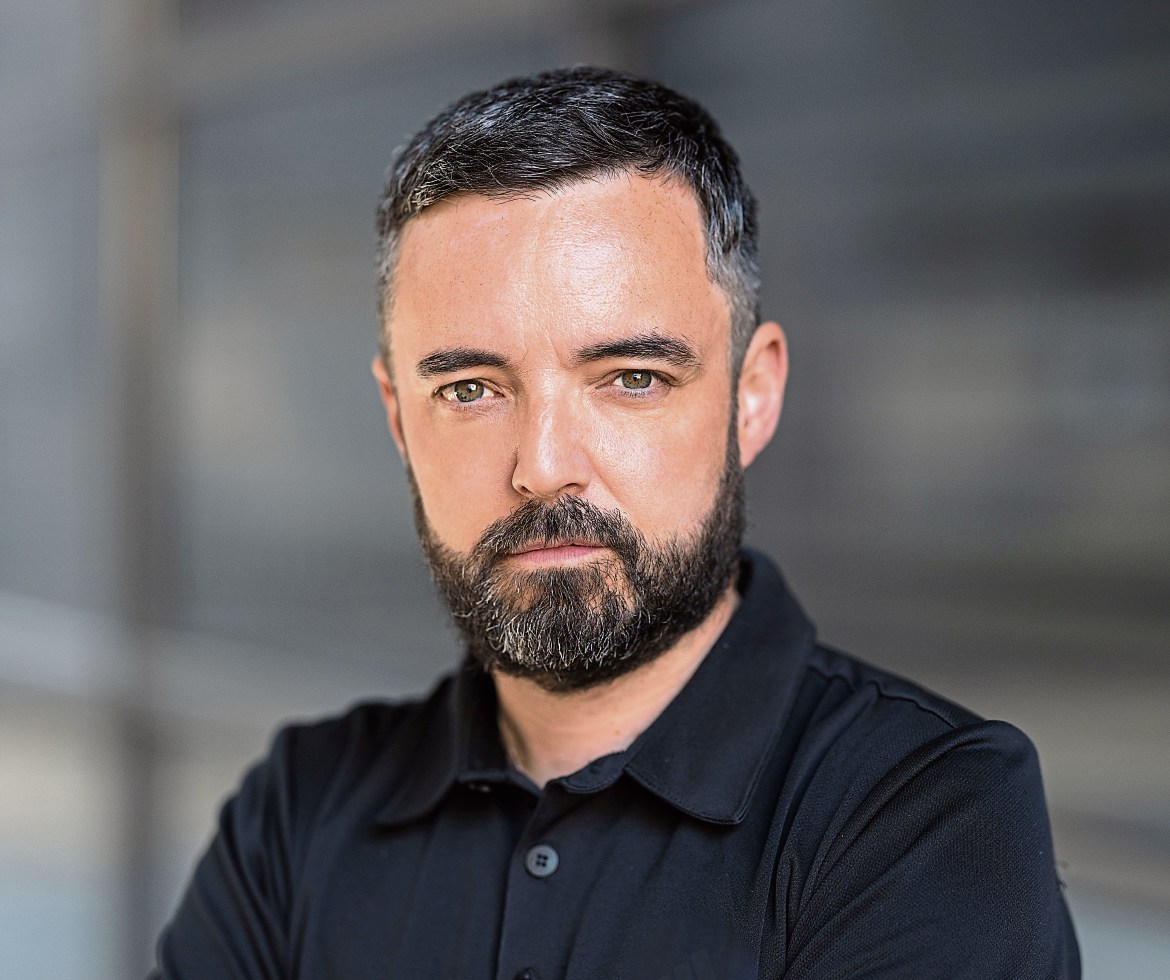


In this week’s The Third Degree column, Paul Bradley speaks with Michael McLaughlin, actor, director and producer.
Hi Michael, thank you for taking this interview. How are you these days? Could you tell us a little bit about yourself first, please.
I’m great, thanks. A bit about me: I was born and raised in Ballyliffin, one of three siblings. Our family has run businesses in the village for over 70 years, including a grocery store, hardware shop, tweed factory and dancehall during the show-band era.
My parents instilled a strong work ethic in me, which has always been central to everything I do.
After college, I lived abroad in Holland and then spent a few years in London. Later, I returned home to take over the family business and build the great team we now have in Ballyliffin. This development allowed me to focus more on the arts while remaining passionate about working with people.
I then began acting, writing and directing short films and music videos. I’m currently producing a new short film called Fleeting, which is set right here in Donegal.
You write, act, narrate, direct and produce…can that be too busy at times: are you constantly switching from one to another, or do you have a strict scheduling system?
I wouldn’t have it any other way. My boredom threshold is incredibly low and constantly moving between projects keeps me energised.
Last week I was rehearsing a play I wrote during lockdown called The Last Corncrake, which was shortlisted for the Millennium Theatre New Writing Bursary. Then I flew to London to record voiceovers at Piccadilly Circus.
Currently I’m working on several short films and trying to option a book. So yes, I’m constantly switching between disciplines. I don’t think I’ll always be able to do that but while I can, I will.
What draws you to a particular project (or a particular role within it)? Are there things that you would like to be a part of, but think you’d be better as a director than an actor, or vice versa, for example?
For me, storytelling is the foundation. I always consider the writer’s intent and how I can authentically interpret it. This principle applies to acting, directing and even producing.
I must believe in the story and I’ve declined projects I felt might better suit someone else.
Was the love of drama in you from childhood, or something that developed slowly?
Michael Fassbender frequently draws parallels between his time as an altar boy and his eventual acting career. He describes putting on a costume performing before an audience and earning money from weddings and funerals. I find this connection quite similar to my own experiences.
As a child, I participated in school plays and then ended up touring several national theatre productions later in life so the stage will always hold a special place in my heart.
You’ve been a keen promoter of Donegal in your work, possibly most famously in the short film Atlantic Roar. Is that something you see as a responsibility for someone with the media presence you have, or is it more of a passionpleasure?
I’m reminded of that recent internet meme where a social media user declared they’d “never met someone from Donegal who wasn’t outrageously delighted to be from there!”
I’m incredibly proud of my roots here. There’s a warmth and resilience among the people that, despite lacking government investment in infrastructure and the like, we’ll prevail against all odds.
Atlantic Roar achieved remarkable success, garnering over half a million online views and even being picked up by Aer Lingus for its inflight system. This really boosted my profile as an actor and producerfilmmaker.
On a related, but darker note, do you think it’s important that people with a public profile take a stance on certain serious issues – most prominently at the minute with the situation in Gaza, about which you’ve been vocal yourself?
I believe that’s a personal choice but I’m saddened when those with platforms fail to use them to highlight injustice and show solidarity with vulnerable people worldwide, whether domestically or internationally. Empathy has unfortunately become conditional.
Palestine has always fascinated me as it seemed to encapsulate international conflict. I often thought if we could resolve the Palestinian issue and condemn Israel’s brutal occupation we could address many other war zones.
This inspired me to visit the West Bank of Palestine in 2017 and work with a theatre company in a refugee camp there. We devised ways to use the arts as a form of rebellion and resistance.
I witnessed firsthand the inequality faced by the indigenous people and my heart has been broken ever since. The cruelty, injustice and displacement have only worsened and countless lives continue to be lost despite an apparent ceasefire.
If so, can there be a danger in that too, in that some people may indeed have a hugely influential public profile but without any actual insight/information/judgement?
The rise of social media has turned everyone into an armchair expert and sometimes those with the least knowledge can be the loudest. The saying “an empty vessel makes the most noise” springs to mind.
You’re also involved with the Disappear Here Film Festival, coming up in October. Where did that idea come from, and can you give us any clues about what we might expect there this year?
Yes, I’m the founder of DHFF, which is now entering its tenth year in 2026. This idea originated from my passion for film, particularly short films.
After moving back to Donegal in the 2010s, I realised I had to travel to film festivals to see what was happening nationally. I attended festivals worldwide and thought Ballyliffin, despite lacking a cinema, was ideally suited for an international film festival. However, I discovered the village had a rich history of unusual film screenings long before I was born, including an old coal shed cinema at the Strand Hotel.
The name ‘Disappear Here’ comes from a cult novel by Bret Easton Ellis, ‘Less Than Zero’. I thought it perfect as our audience disappears into the seats, into the darkness, into the action on screen and into the welcoming Donegal landscape afterwards.
I met the author at a book signing in Dublin a few years ago and he gave the festival his blessing, even signing one of our posters.
In Donegal, how important is the support of Arts Councils and the Donegal Film Office for the local industry? (It’s less glamorous than having the Millennium Falcon here, but is it quietly more useful…?)
In rural areas like Ballyliffin, events like ours depend heavily on support from state bodies such as the Arts Council, Fáilte Ireland and the Donegal Film Office through Donegal County Council. Without this support, our event simply wouldn’t be possible.
We’re incredibly grateful for the ongoing support that brings cultural events to isolated communities yearning for the arts. Furthermore, the Film Office serves as a valuable link for production companies considering Donegal as a location and supports skills development within the county.
Are you busy at the moment with any other projects we might see in the future?
I’m incredibly busy at the moment, even for this time of year. Recently I was producing a new short film called Fleeting up near Donegal Airport. It features two emerging female forces to be reckoned with: Director Bébhinn Naughton and Writer Shannon Welby, both from Donegal.
I’m now working on a six-week feature film in Culdaff so keep an eye out for both of those on the festival circuit and in cinemas nationwide in the coming months.