




By Paul Bradley
Long before Letterkenny existed as a town there was Oldtown (or “the Auldtown”).
In fact, as you might guess from the name, it was a very early place of settlement, probably going back 4,000 years, with people drawn to a landscape very different to today’s: the Swilly estuary extended almost as far as New Mills, so today’s mild flatlands were once the sea’s tidal edges.
The rising ground of Oldtown was safely above that tide, the river offering easy access to food and transport, and there were hills nearby for livestock.
Another attractive feature was a rare natural crossing point of the River Swilly, a shallow, gravelly ford that could be waded at low tide. That stretch, from the Oldtown area out past Crievesmith, was known as Ath-Thairsi (Ford of Protection), and was important to traders and travellers; it’s possible that the first buildings at Oldtown were built to shelter travellers gathering at the river waiting for the right conditions to cross. And of course it was of interest to military men; which, after 1250 CE, meant the O’Donnells, whose territory, Tír Luighdheach, included the area where Letterkenny is today.
That meant the area witnessed its share of history, largely forgotten today.
It was at Ath-Thairsi that Godfrey O’Donnell, the 13th-century king of Tír Conaill, died in 1258. He had received serious wounds the previous year at the Battle of Credan, fighting the Norman lord Maurice FitzGerald — FitzGerald died immediately, Godfrey survived long enough to lead his forces to a further victory over the O’Neills. After that battle he succumbed to his wounds at Ath-Thairsi, and was buried at Conwal Cemetery.
Some 309 years later, on May 8, 1567, one of the most consequential battles in Ulster’s Gaelic history was fought between Shane O’Neill of Tír Eoghain and Hugh O’Donnell of Tír Conaill. This was the Battle of Farsetmore (Fearsad Suilighe Mór, ‘the sandbank of the Swilly’), another river-crossing (near today’s airfield) where mudflats met steep ground.
Shane O’Neill (“Shane the Proud”) wanted to control Ulster, and spent two decades eliminating rivals and asserting authority over neighbouring clans. He even kidnapped the O’Donnell leader Calvagh (who owned a castle at Scarrifhollis, another reliable crossing point) and held him captive.
By 1567, the new O’Donnell chieftain Hugh was ready to settle things. When their armies (about 2,000 men each) met at Farsetmore, O’Neill’s forces were trapped by geography and routed by the O’Donnells.
They were already on the wrong side of the fighting when the tide rose up, swamping their paths and drowning men and horses (a sandbank there is still called the Horseman’s Bank).
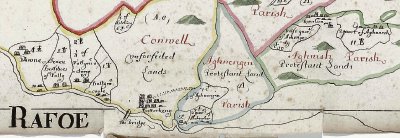
The Oldtown bridge, first built by about 1620; is depicted as “The Bridge” on the Down Survey map of 1655–6.
O’Neill lost around 1,300 men before fleeing to Ath-Thairsi to cross the river again and get back to Tyrone. But his power was broken. Desperate for a new military alliance, he turned to the MacDonnells of Antrim, who killed him during negotiations on 2 June 1567 (and sent his head to Dublin for display on the Castle Walls).
Farsetmore was the last major battle between the O’Neills and O’Donnells before their eventual unification in the Nine Years’ War — a chain of events that ended with the Flight of the Earls in 1607, the Plantation of Ulster and the founding of Letterkenny itself.
That founding began when, in 1611, King James awarded the lands to Patrick Crawford for his efforts in suppressing the rebellion of Sir Cahir O’Doherty. Crawford immediately began to plan a new market town, which of course needed a bridge – and Oldtown was the natural site.
Work on it had begun by 1613, but Crawford never saw it completed: he was killed in 1615 fighting in Scotland. His widow Joanna Everard then married George Marbury, and as the town’s new “top couple” they lived in the Oldtown area (then a settlement of about 50 thatched houses) and completed many of Crawford’s plans.
That included the Oldtown bridge, first built by about 1620; it’s depicted (as “The Bridge”) on the Down Survey map of 1655–6. This was not the bridge we have today, though: that was built around 1720 (perhaps using some material from the first bridge), the first stone bridge across the Swilly, and one of the most historically significant structures in the county.
A 1662 Catholic pamphlet called “A collection of some of the murthers and massacres committed on the Irish” says that in 1641 “The Governour of Letter Kenney, gathered together on a Sunday morning 53 poor people, most of them women and children, and caused them to be throwne off the Bridge into the River and drowned them all.”
That certainly fits the violence of the time, though some modern historians are slightly circumspect: there are no official records closer to 1641, that area of the river was its shallow point, and at that time (reflecting the 1641 Portadown massacre of 100 Protestants) there were so many stories of groups being thrown off bridges that it may have become a “viral” tit-for-tat allegation; truth may be impossible to disentangle from folklore here.
As Letterkenny grew in the 18th and 19th centuries, Oldtown’s proximity to the river was crucial. It’s easy to forget that Letterkenny was a port town (Oldtown and other low-lying areas out as far as Newmills used to flood up to a few years ago), and small vessels, sailing up as far as Oldtown or Newmills, would import coal, timber, and salt, while grain and cattle were exported.
Oldtown also provided the labourers and the storehouses to keep this economy functioning.
There’s a famous bit of Oldtown folklore from this period, in which a resident of Oldtown (usually said to be an elderly woman) went to bed and left a candle burning. Her cat knocked the candle over and started a fire that engulfed many of the (thatched) houses nearby.
The cat story is almost certainly not true, but the story preserves a memory of a major fire (or fires) that happened around 1820. It’s said that this disaster forced the modern development of Letterkenny to move away from the river and toward its current layout on the hill (the older houses and shops of Main Street date to the mid-19th century).
Later, as the water retreated, the arrival of the railway in the late 19th century added a new bustle to Oldtown. Steam engines, stopping where the Station House Hotel is now, moved goods and people across the county, and farmers brought their livestock to the nearby marts.
But as the railway tracks disappeared, so did much of the local employment and social hubbub.
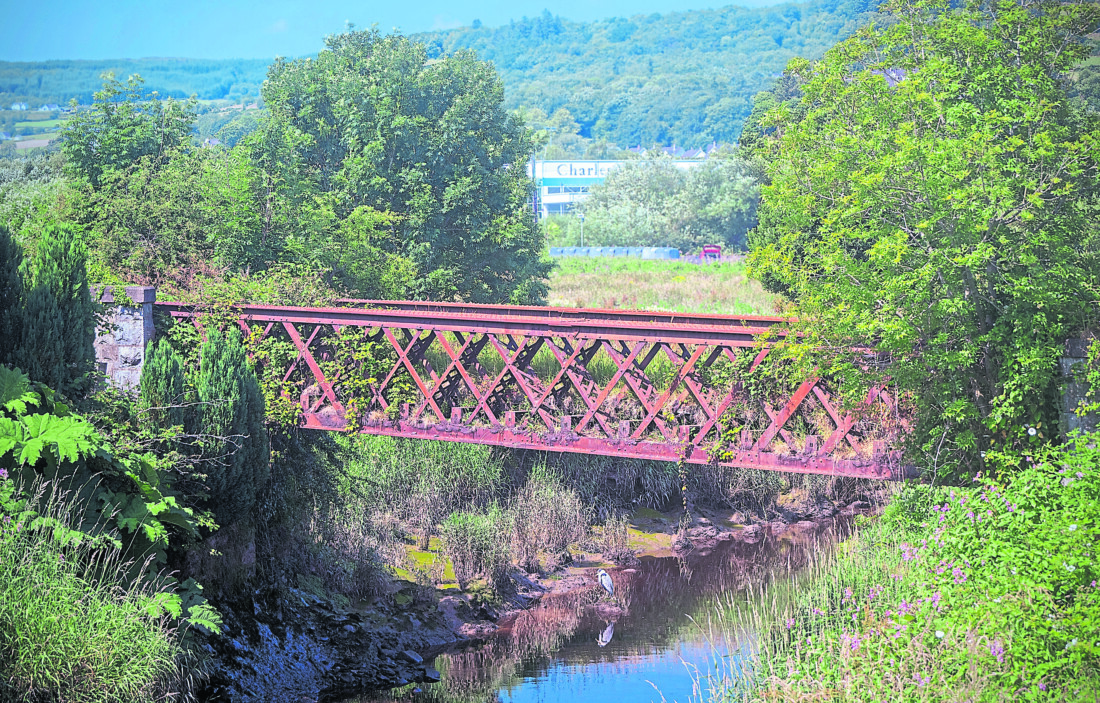
You can still see the old railway bridge, a stone’s throw from the Oldtown bridge (it’s derelict now, last used regularly, I suspect, by a particular bunch of youngsters fishing for eels and flounder).
This bridge was built by the Londonderry and Lough Swilly Railway Company as part of the ambitious Derry to Burtonport Railway railway line, which opened in March 1903 and closed in stages between 1940 and 1953.

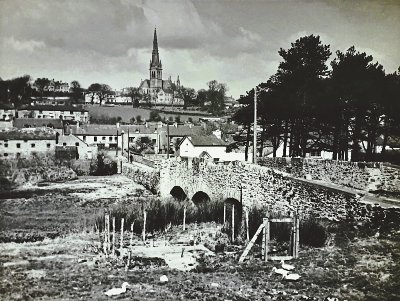
Oldtown Bridge, 1960. Photo: Charles Doherty, from The Capuchin Archives