


By Maddeleana M Merrigan
ON July 20, 1969, the world stood still in nervous anticipation as Apollo 11 landed on the surface of the moon. Ancient civilizations used the moon’s phases to track time and tide, create calendars and plan agricultural activities.
Like a trusted old friend, it has become a constant in every day life. Some worshipped it, while others simply used it as a guiding light in the dark. For NASA it was a challenge.
The moon landing, globally televised, was beamed in real time to the living rooms of millions. For perhaps the first time in history, a communal sense of excitement and anticipation was shared world wide as the shuttle door opened and the very brave Neil Armstrong descended, placed his foot on the moon’s surface and delivered the famous line…‘One small step for man, one giant leap for mankind’.
And from this incredible moment, a new era was born. No longer bound to earth, the possibilities of interstellar travel was not the work of fiction but became a future possibility.
SOVIETS
The project was born under the iconic presidency of John F Kennedy, who was determined to fulfil a vision of American technological superiority – to land a man on the moon and return him safely to earth – while winning the space race against the Soviets.
The build up to this monumental event involved the input of over 400,000 skilled people including Dr Peter Coyle BSc Ph.D. and native of Inver, County Donegal. He was appointed as Technical Specialist at Dow Chemicals headquarters in Michigan, in 1964. As part of the space mission, the company was requisitioned to invent a resin capable of resisting the inhospitable atmosphere of outer space. Dr Coyle and his colleagues worked on a chemical process called sputtering in an attempt to balance the space capsule’s temperature on the journey.
He was instrumental in successfully designing Epoxy Novolac, a highly chemical resistant coating which was applied to the outer casing of the space capsule. Dow corning silicones were used in seals and insulation in the heat shield to protect the spacecraft during re-entry. With his colleagues, Dr Coyle’s major contribution rendered the historic mission possible.
“It isn’t something I wake up every morning thinking about but yes, I am rather proud of being a small detail in what was a really huge machine.
“I did various things before becoming manager of the Dow epoxy business. Kennedy had already announced that he wanted to go to the moon but by 1968 we were seven years in and there was still a big problem – how to get the craft through the earth’s atmosphere with three astronauts on board when it is burning at around 5,000 degrees Fahrenheit, which is pretty hot.”
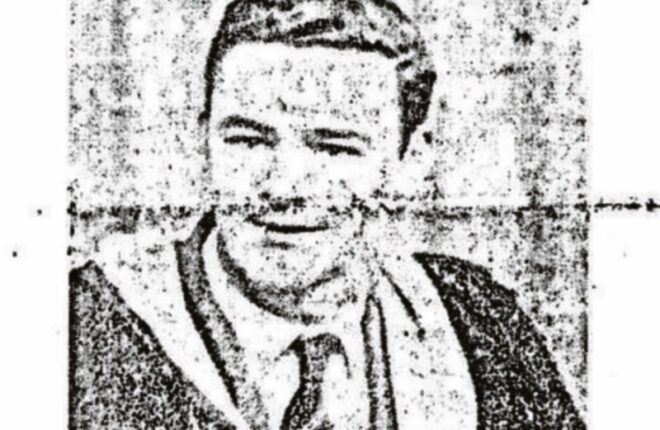
How Dr Coyle looked in the Donegal News back in 1969.
Dr Coyle was in Michigan as the world watched Apollo 11 take off from Cape Canaveral.
“I was in Midland, Michigan, watching it on television and I think the entire US must have come to a stop. Everyone was so happy when it got up because we thought something was going to go wrong, that it would explode in the pit. We didn’t have a reliable history at that time and quite a few astronauts had lost their lives previously. It was dangerous every step of the way.”
He voiced his immense pride in the astronauts and everyone involved, especially NASA and the various corporations who delivered to make the mission possible. Technology at the time, by today’s standards, was limited.
“The iPhone that people carry around daily is way more powerful than what was available back in the 1960s.”
Dr Coyle was born in Inver, a quaint, charming village on Ireland’s Southwest coast where the River Eany meets Donegal Bay. It was known as the hidden jewel of the north west for its beautiful coastal scenery and historic whaling past. He was the grandson of William Hemmersbach, once one of the best known hoteliers in Donegal and former owner of the local and very popular Drumbeg Hotel. He attended the local Keelogs National School and moved to Newbridge Dominican College as a border. In 1955 he obtained a scholarship to UCD where he received a BSc Honours Degree. He then moved to Leeds University and was awarded a PhD in radiation chemistry.
HEROES
In recognition of the importance of his contribution, American Attache, Colonel Joseph O’Connor, travelled to Inver in November, 1969. At a local gathering he personally thanked Florence Dunleavy (Dr Coyle’s mother) for the significant role her son played in the Apollo 11 project, noting that Donegal should be proud of her son.
From Inver to the moon, Dr. Coyle’s name will forever be a part of taking moon travel out of the comic books and the imagination and making it a reality. He encouraged people to acknowledge the three astronauts, Armstrong, Aldrin and Collins, whom he claims were the real heroes noting: “We knew very little about space. It was like when Columbus went to the Americas, he crossed this vast sea that had never been mapped. Obviously we knew where the moon was but the physical process of getting us there and the capabilities of the machinery and controls we had were all so primitive.”