


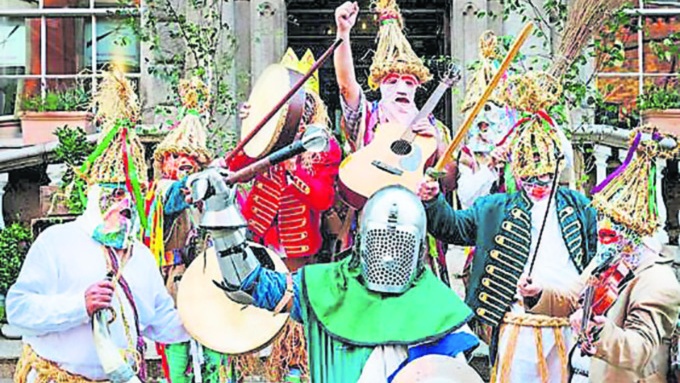


WHATEVER your beliefs and however you celebrate, Christmas is a deep, highly peculiar repository of old traditions drawn from all over (mainly Northern Europe) and mixed together into localised ones that are often fun but sometimes hard to understand these days.
One such tradition, now a fairly vestigial one, is Mummering (or Mumming), which was common enough within living memory (and at Halloween as well as at Christmas) but rarely practised these days, normally only surviving in curtailed and less strange form.
But Donegal is one of the places where you might still catch occasional sight of the Mummers, those half eerie, half comical masked performers who’ve spent centuries bringing their odd blend of drama, music and bawdiness to communities.
Traditional Mummering is a folk play or procession performed by disguised individuals, moving from house to house; they might appear at any festival time, but primarily around Christmas.
While variations exist across Ireland and elsewhere, the fundamental elements remain: costumes, music, and a performance that often culminates in a symbolic battle and resurrection.
Don’t let that word, “resurrection” mislead, though: Mummering far predates Christianity. Some elements of it (masked solstice performers in elaborate natural disguises) go back at least 2500 years in Ireland alone, and others have been added with time: the Annals of Ulster refer to the conical-hatted entertainers in the court of King Conor MacNessa (which likely places it in the first millennium), while the word “Mumming” itself was first recorded as part of King Henry’s Christmas celebrations in Dublin in 1172. Finally, the main characters of the “Mummering play” arrived here following the Plantation.
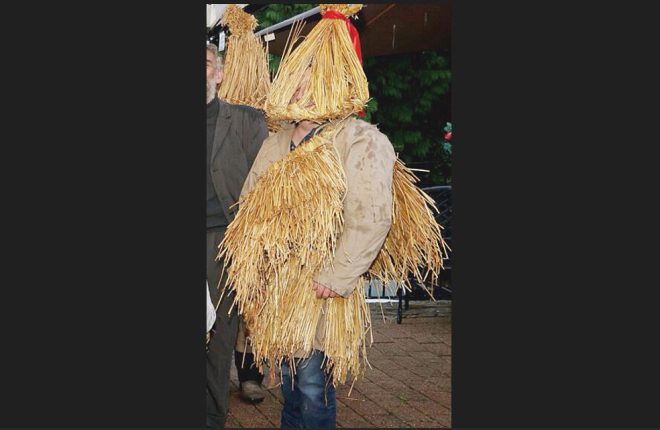
Donegal Mummering has its own flavour. The distinctive straw costumes and conical hats have always been popular here.
Ultimately, though, its origins lie in ancient pagan festivals celebrating the winter solstice. These were times of spiritual and physical vulnerability, when the veil between worlds was thin, and people sought to influence the coming agricultural year through symbolic acts.
The themes of death and rebirth, central to Mummer plays, directly reflect the dying light of winter and the hopeful return of spring. The disguise, the noise, and the mock battles were believed to ward off evil spirits and usher in good fortune for the household.
As Christianity spread, these ancient customs weren’t so much eradicated as assimilated. The twelve days of Christmas, a liminal period of both sacred observance and continued revelry, were entirely suited to Mummering and its messages.
Mummers (also known as Christmas Rhymers) in noisy procession and paper or straw disguises, would move through the community, knocking on doors (traditionally of homes, more likely a pub or hotel these days) and making cheerfully rowdy.
The homeowners, knowing their part, would try to figure out the Mummers’ identity, then offer food, drink, and perhaps a small gift in exchange for the performance and the good luck it bestowed. Yes, all that is very much in the DNA of the plastic Halloween “trick or treat” rituals we have these days – in fact, even before the film ET started that American tradition in Ireland, it was common enough for children here to dress up and knock on doors simply begging some “money for the Mummers.”
Donegal Mummering has its own flavour. The distinctive straw costumes and conical hats have always been popular here (visibly linking the rituals back to agriculture and fertility), and while most other traditions were largely spoken word, Donegal Mummering is intrinsically linked to traditional Irish music.
In fact you might still see a Christmas Mummers night in Creeslough, for example, which is almost entirely musical and relatively light on the traditional costumes and theatre.
Speaking of the theatre, at the centre of Mummering was the “play” performed by the Mummers: usually short and dotted with comments to the audience, and populated by a recurring cast of archetypal characters, each with their own significance.
Actually in Donegal the characters’ names were often unimportant, and elsewhere they varied from region to region: there’d be St George or St Patrick, the hero warrior, who engages the antagonist the Turkish Knight or the Black Prince in battle; and the Doctor, a comical character who, most crucially, brings the fallen hero back to life.
After the hero has been revived, a secondary cast would enter to sing and collect money from audiences, with characters like Beelzebub or Jack Straw (“such a man you never saw”).
Other related characters like the Hobby Horse were less likely to appear in Donegal Mummering, but it was part of the same original family and would appear in the plays in other areas of Ireland (often under the name An Láir Bhán, or the White Mare): you’ll certainly recognise it from films like The Wicker Man, which points to the ancient paganism and animal totems from which these rituals emerged.
From the mid-20th century, like many traditional customs, Mummering declined due to changing social patterns and the rise of mass media. But some communities, often supported by local heritage groups, have actively worked to keep it alive in the 21st century: areas like Creeslough, Gweebarra, Moville, and Glengad have seen resurgences.
It’s still around in places in North America too: as one example, Scots-Irish emigrants took the traditions with them when they left for Pennsylvania, where it’s still marked by the Mummers Parade in Philadelphia every New Year’s Day.
As a side note, Mummers are not quite the same as Wren Boys these days. They share ancient roots, and their rituals (visiting houses, promoting good fortune) and appearances (straw costumes in particular) are still similar, but over time they diverged, as different customs were emphasised differently from place to place.
Written by Paul Bradley.