


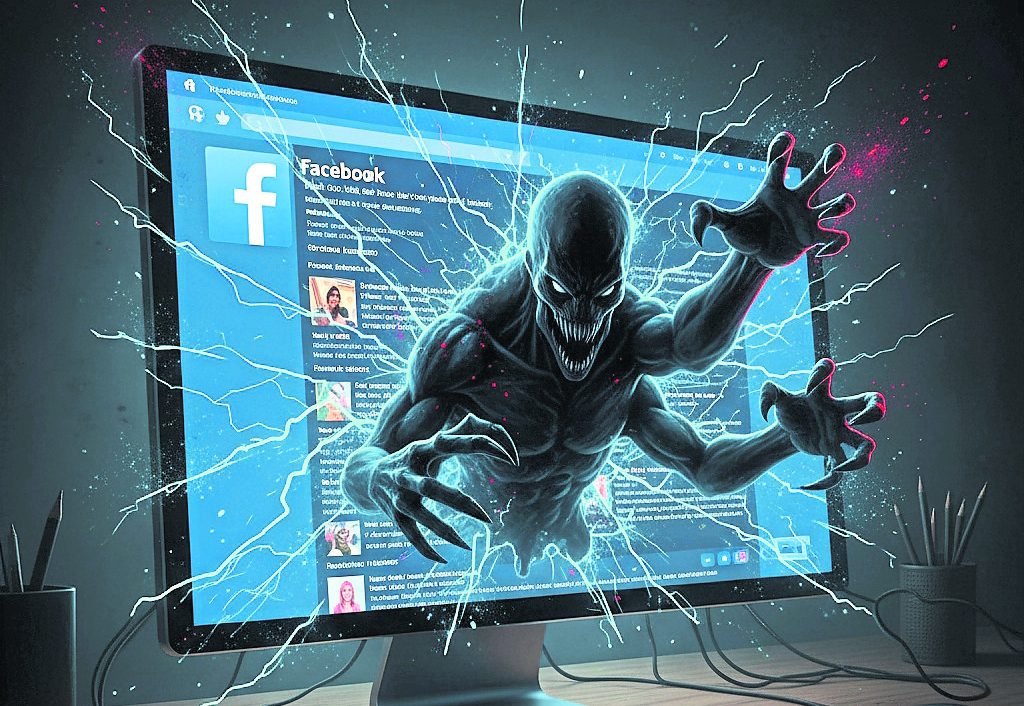


Donegal News columnist Paul Bradley is still wondering how his Facebook account was hacked…
So I’ve been hacked: after years of wondering how it seemed to happen to so many people, it’s happened to me.
On a recent Sunday evening, while I watched a bit of telly (yes, I’m always working…), my Facebook account began sending nasty videos to my contacts. It was, as ever, Lady Bradley who alerted me, just four minutes after she had received the video; by which time, I discovered, my account had already been shut down by Facebook.
The quick intervention did at least limit possible damage, taking it out of the hacker’s hands. But actually reclaiming ownership was daunting, initially resulting in an email saying “Your Facebook account has been permanently disabled. You can’t request another review.”
That’s AI’s version of due process for you: shut out of your own pages and everything you had there, without the chance to present your case.
I did try. But it’s agonising, and it’s apparently fruitless. There’s no support line to call; the online guidelines send you in circles, often advising you to log in to the very account they’ve locked you out of.
Here I am, one month and many emails later, and I have yet to receive even an acknowledgement from Empire FB: not so much as an “email received.”
I suspect they are deliberately opaque: Facebook is probably too globally vast (over 3 billion customers) to deal with even a small percentage of issues like this, and frankly, with an annual turnover of $135 billion, it’s long past having to pretend to care about the customers who have put it there.
But all the byzantine stonewalling comes when you are already stressed about what’s happened, and what your contacts make of the messages apparently coming from you.
But what had happened? I still do not know. I’m not even sure which device had been hacked.
I do remember that, earlier that same day, I was frustrated by a very slow Photoshop update, only later realising that maybe it was not Photoshop but something malicious that had caused the laptop’s stuttering, error-messaging performance. Was it linked to that phone call I had mistakenly answered a week before, in which I acknowledged my name before noticing the accents and the background noise (and hanging up)? Maybe.
What about that Instagram personality test I had tried a month or two before? Maybe. But again, I don’t know.
Malware scans told me my laptop and phone were both clean, and that my email had not been compromised. And I have always been a careful user: I watch out for bundleware, scan and clean everything regularly, and in 16 years with Facebook had never had an issue.
But as I read more deeply into it, I began to feel that nothing at all was safe. In fact it seems that several million people have had this exact experience with FB over the past two years; none of them have found a solution, but there is at least one group trying to put together a vast class action lawsuit against FB.
It’s alarming, the many ways in which your details can be “phished” without anything being installed on your computer. Of course we try not to click on links in emails or messages anymore unless we’re sure of the source, but nowadays scam messages can look genuine.
A leak of 183 million email addresses had been in the news just three days before my problems began, but that pales beside the leak of 16 billion sets of complete login details from earlier this year.
There are keyloggers, which record your typing. There is “cookie theft” which helps a hacker masquerade as you. And there are the innumerable “click here for more” promotions that pepper social media: all are annoying, some are dangerous.
What’s all the hacking about anyway? It varies. Some is broadly political, some is about theft (financial and identity), but some, the most confounding kind, appears to be just gleeful malice. That’s what happened to me: why else would someone hack into Facebook, only to immediately have it shut down before it can be used for anything?
There’s no obvious gain. Is the hacker, as Joker told Batman, just “an agent of chaos”? How do we tackle that? What do we offer someone who doesn’t want anything, except, essentially, to use their considerable skills to enter a stranger’s home, smash their things, and leave?
Smarter people than I are still figuring that out. And I’m relatively lucky, as there was nothing incriminating or risky on my page, and I had very little faith in human nature to lose. And there was a lot I really did not love about Facebook: the algorithm, the inane comments, the barrage of adverts.
But it was also where the groups were that I followed; where the people I knew were, and where the people they knew were; the simplest place to gather local discussion and information, and to contact people with whom I had no other links (for an interview for this paper, for example). All that is gone now: the histories, the banter, the photos, the contacts. All harmless, all obliterated.
So I have learned, somewhat painfully, how vulnerable we are online, how even long-term internet users of the most cynical persuasion can fall victim without noticing.
Don’t click on anything you’re not absolutely sure of; certainly not anything interactive, not even those innocent-looking personality tests.
Don’t keep all your passwords in your browser’s “credential manager”. Don’t use the same password on multiple accounts: that’s just a skeleton key to everything. Use a VPN. Be careful of the “social” part of “social media”, and keep interactions to a minimum.
Most of all, I felt angry (with the hacker for breaking my account, and with Facebook for not even bothering to shrug dismissively) and somewhat embarrassed, even though anyone seeing the messages would see them right away for a malicious attack. At least, I hoped they would – and that slight doubt, in the end, is just another unease it plants in your mind.
There is, as I write this, one small update. Instead of YouTube, I use a third-party app called Smarttube which eliminates the frankly unwatchable ads. I have just discovered – because it has been removed from my TV, pending a new version – that the last few versions had been cracked, and malicious code hidden in them (by hackers, not by the developers) which searches for personal information. This is what I now suspect happened in my case. It’s a good app, but be sure to update to the latest version.
And if you’re at all curious about the results I got from that personality test I did a month earlier, well, it turns out that “big buck eejit” is a legitimate psychological diagnosis after all.