


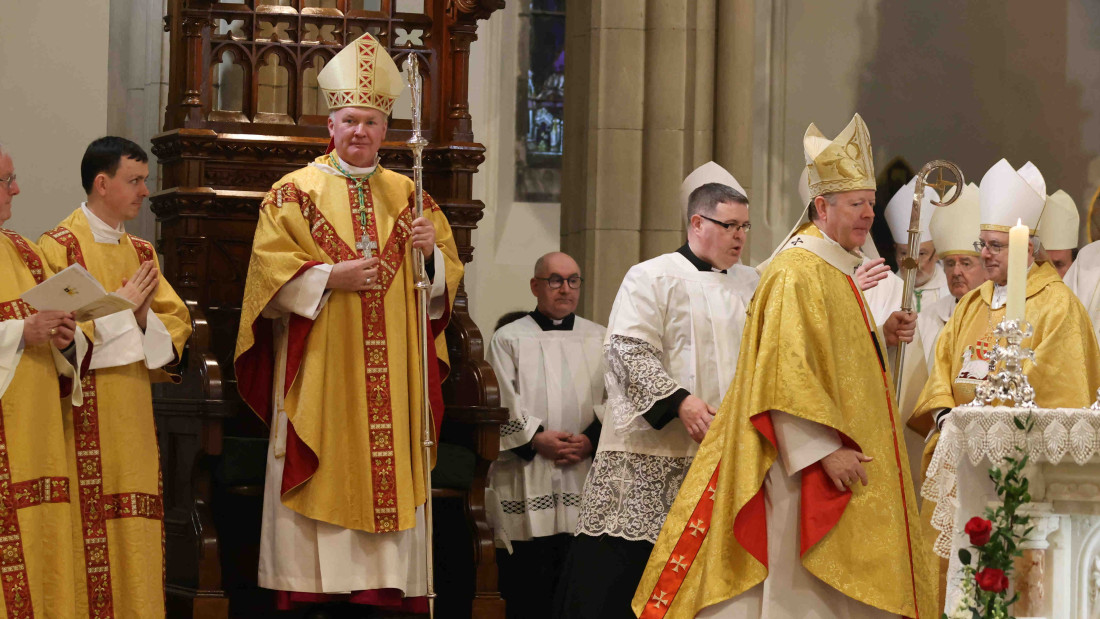


The Installation ceremony of Bishop Niall Coll as Bishop of Raphoe is this evening continuing at St Eunan’s Cathedral in Letterkenny.
The ceremony opened earlier this afternoon with a special welcome by Archbishop Eamon Martin, Metropolitan Archbishop of Armagh and Primate of All Ireland who noted how it was such a special day for the Coll family, and especially Bishop Coll’s mother, Kathleen.
“You are very much in our thoughts and prayers this afternoon. I am sure that you are delighted to have Bishop Niall back home again,” Archbishop Martin said.
He said it was an honour and a joy to be in St Eunan’s Cathedral to install a son of Donegal, “one of your own”, Bishop Niall Coll to be the next Bishop of the Diocese of Raphoe.
Archbishop Martin also offered a special welcome to Cardinal Sean Brady who was also in attendance, along with His Excellency Archbishop Luis M Montemayor, Apostolic Nuncio to Ireland; Bishop Alan McGuckian SJ, Bishop of Down and Connor and Bishop Philip Boyce, Bishop Emeritus of Raphoe.
The ceremony began with Monsignor Kevin Gillespie, on behalf of the priests and people of the diocese, formally receiving Bishop Niall Coll, and offering their respect and loyal assistance.
Following the moment of his Installation during the Mass, Bishop Coll then led the liturgy as Chief Celebrant and delivered the homily as the new Bishop of Raphoe.
Homily of Bishop Niall Coll
The lands of Zebulun and Naphtali, mentioned in the first reading, were backwaters – places marked by invasion, loss, humiliation and neglect. They were regions repeatedly subjected to domination and hardship. And yet it is there, Isaiah says, that the light will dawn. Not in Jerusalem. Not at the centre. But at the edges – places bruised by history.
So, when the Gospel tells us that Jesus began His ministry, not at the centre in Jerusalem among the political and religious elite, but in faraway Galilee, it is not simply a travel detail. The work of Jesus begins on wounded ground; among people whose lives are already complicated and unfinished. He does not wait for ideal conditions. He calls people as they are, in the midst of struggle. To the fishermen mending nets, earning a living, worrying about tomorrow, what does he say to them? Not “Understand me.” Not “Explain this.” He says, “Follow me.” There is no interview. No test of readiness. No assurance that they understand what lies ahead. They are not given a plan. They are given a direction. And they follow.
The Church – the Holy People of God in every generation – lives by that same pattern: called first, understanding later. Faith is not something we master before we move. It is something we learn by walking.
These readings speak very directly to our own time, as we live through a difficult period in the life of the Church and of the world. We live in a strongly secular culture shaped by individualism and materialism. Religious practice has declined. The abuse crisis has damaged trust. Beyond our shores, war and violence scar human lives – not least in Gaza, Ukraine and Sudan – where innocent people continue to suffer grievously. We live in a troubled world marked by conflict, by displacement, poverty and fear.
And yet many have not stopped following. Some of them may follow more quietly now, more cautiously, sometimes with questions and wounds of their own. But they are still praying. Still coming to Mass. Still gathering for funerals. Still bringing children for baptism. Still searching – often tentatively – for meaning, hope and grounding. Faith has not disappeared. But the way people follow has changed.
The question before us is not whether the Church will return to the high levels of practice of fifty or a hundred years ago. The real question is whether we are willing to follow Jesus as He calls us now, in the circumstances we actually face.
Today, the Third Sunday in Ordinary Time, is also Word of God Sunday, inaugurated by Pope Francis in 2020 to underline the central place of Scripture in the life of the Church. We are reminded that the Word of God is not just ink on a page, but God speaking into real human lives. Sometimes it consoles. Sometimes it challenges. Sometimes it asks more of us than we would like. But it always invites response; movement. “Repent,” Jesus says in today’s Gospel, not as a threat, but as a promise. Turn around. Change direction. Follow me. God is close. Life does not have to remain as it is.
It is also worth noting that even in the strongly secularised society, there are small but real signs of a renewed interest in the Word of God, especially among some younger people. It seems that some find the well-being focus in school, college and wider culture to be threadbare, and they are discovering a renewed curiosity about Scripture, a search for silence and meaning, and a willingness to listen rather than dismiss. It will be interesting to see how this trend unfolds.
Standing here today, in this diocese, it is hard not to hear something familiar in these readings. The Diocese of Raphoe, like County Donegal, in general has never claimed to be at the centre of things. And yet it carries a deep memory of faith, faith that has been shaped by hardship, loss, emigration and perseverance. Faith that endured because people kept following, even when the road was long and the rewards were not obvious.
That kind of faith matters. Because the Gospel does not spread primarily through influence or argument. It spreads because people choose, day after day, to follow Jesus in ordinary lives – caring for neighbours, welcoming the stranger, standing with the poor and taking responsibility for the world God has entrusted to us.
Following Jesus always has consequences. It draws us towards those who are vulnerable. It sharpens our concern for the poor and the forgotten. It deepens our responsibility, as Pope Francis in Laudato Si’ underlined, for the earth itself, our common home, which bears the marks of human neglect and greed. To follow Christ is not only to pray and to believe – it is to live differently.
That brings me to Saint Colmcille, so deeply woven into the story of this diocese. His faith was not comfortable or uncomplicated. Scripture shaped his choices. Prayer ordered his days. Learning formed people who could carry faith beyond their own generation. He knew that following Christ has a cost. His life included conflict, regret and loss. Yet he did not turn back when the road became difficult.
Colmcille reminds us that following Jesus is not about perfection. It is about perseverance. It is about remaining on the path even when faith becomes demanding and when the world resists the Gospel’s call to justice, mercy and peace. I hope the cards you received today bearing an image of Saint Colmcille taken from the stained-glass window in Arranmore Church will help to encourage you to persevere in the faith.
As we look to the future, people are not looking for a Church that pretends to have everything sorted. They are looking for a Church that is credible because it follows Christ honestly – one that recognises ‘Christ Jesus our hope’ (1Tim 1:1) as my episcopal motto puts it – admitting failure, practising real repentance, standing with the wounded and remaining faithful when things are hard.
Evangelisation – the sharing of faith – will not come through dominance or argument. It will come – in the power of the Holy Spirit – through depth: helping people to learn how to pray; staying close to Scripture and Sacrament, especially the Eucharist; forming habits of faith that allow people to keep following when enthusiasm fades; forming consciences attentive to the poor, the suffering and the fragile state of our world.
We are not being asked to recreate the past. We are being asked to follow Jesus now – to bring the Gospel home into families, parishes and ordinary lives; to water the garden that is already here. This work is slow. It requires patience and trust. But it is the work that lasts.
Today, as I am installed as Bishop of Raphoe, it would be tempting to speak about plans and priorities. But before any bishop teaches or governs, he must first be a disciple, one who follows. He must listen to the Word of God and walk with the people. A bishop does not stand above the call to discipleship. He stands within it.
I come among you knowing that I do not have all the answers. But I want to follow with you – to listen, to learn and to serve the Gospel together. Jesus did not say to the fishermen, “Understand me.” He said, “Follow me.” And they stepped forward.
We are living through uncertainty, in a wounded Church and a wounded world. But the Gospel does not call us to stand still or to look backwards. It calls us to movement – towards God and towards one another.
The Church does not exist to preserve itself. It exists to follow Christ and to bring light where it is needed – in places of poverty and injustice, in lands torn by war, in hearts burdened by fear and in a creation that longs for healing.
The first disciples misunderstood often. They failed publicly. They fled. And yet they were entrusted with the Gospel. That should give us hope. God does not depend on flawless followers – only on faithful ones.
So today, in our diocese, with these readings before us, one truth stands out: the Church does not begin with strategy. It begins with following.
- Following the Word that still calls people by name.
- Following the Word that gathers what is scattered.
- Following the Word that sends us out: to care, to serve and to witness.
My prayer today is simple: that together – clergy, religious and lay faithful – we may keep following Jesus, closely enough to be challenged by Him, changed by Him and sent by Him. Because those who once walked in darkness are still waiting for light. And God, as ever, chooses to let that light begin among ordinary people who are willing to follow.
Téimis ar aghaidh le chéile agus muid lán le muinín. A Mhuire, a Mháthair na hEaglaise, guigh orainne.
A Cholmcille, a Adhamhnáin, a Bhríd guigí orainn.