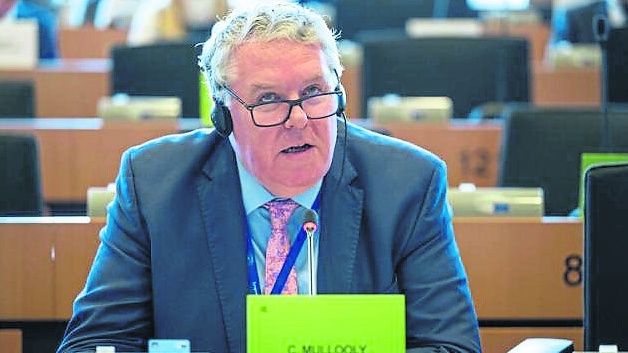


Midlands–North-West MEP Ciaran Mullooly has questioned EU Housing Commissioner Dan Jørgensen on the impact of short-term rentals on Gaeltacht and rural communities, housing speculation, and delays in delivering new homes caused by fragmented planning systems. The exchange took place in the European Parliament’s Housing Crisis Committee (HOUS), where Mullooly is Vice-Chair, as part of the European Commission’s engagement with Parliament on its developing housing initiative ahead of a forthcoming EU housing summit.
Commenting after the meeting, Mullooly said the issue of short-term rentals was one he had raised repeatedly on behalf of communities in the Connemara Gaeltacht, as well as parts of Donegal and Kerry. He said local people had told him they were being priced out of their own areas, unable to compete when homes came on the market, with many properties subsequently being placed directly into short-term letting.
Mullooly said he had therefore asked the Commissioner last year to examine how the EU could respond in villages, towns and cities where housing markets are under severe pressure, and welcomed the fact that the Commission has now come forward with proposals that allow action in designated stressed housing areas. He noted that the approach does not involve a blanket ban on short-term rentals, but instead provides for restrictions on new short-term letting activity in areas where housing supply is under acute strain – a category that can include Gaeltacht and similar communities.
Raising the issue formally again in committee, Mullooly questioned how the Commission intended to act across Member States in order to have full clarity on this:
“You’re looking at the stress zones. Hands up, we can’t touch the overall, we can’t ban, but you’re looking at specific categories. And I’m still wondering how you’re going to legislate across Member States to be able to do this.” He highlighted that housing pressures were not confined to major cities, referring to the west coast of Ireland:
“Even in parts of the western seaboard of Ireland… where local people cannot buy homes, but people with the richest of this world can come in and buy derelict properties and set up B&Bs under booking.com or Airbnb, et cetera.”
Responding, Commissioner Jørgensen said the Commission’s approach would focus on enabling action in stressed housing areas regardless of size, something which can apply to Gaeltacht areas : “We do think that’s a pretty good idea,” the Commissioner said, “and it will give the tools that many of the mayors that I’ve met with have asked about.” He added: “This is not just something for Amsterdam and Barcelona and Copenhagen. It’s also for smaller cities.”
Mullooly was also critical of the Commission’s approach to housing speculation: “I see an awful lot of analysis and greater transparency and peer learning, but I don’t see anything with teeth to take them on.” Jørgensen acknowledged the concern: “I’m probably closest to the ones of you who see a very real problem here… I would be surprised if our analysis does not show that there is a lot of speculation going on here,” he said, while noting that greater transparency was needed.
To illustrate how housing supply could be accelerated, Mullooly outlined a proposal he had examined over Christmas for a new green village in the Irish Midlands, designed as a 15-minute city. The concept he referred to relates to a long-term masterplan proposal for Athlone, Co Westmeath, which remains at concept stage and would be subject to planning and regulatory approvals.
“Over Christmas, I had an opportunity to look at a proposal for a new green village in the Irish Midlands… he’s calling it a 15-minute city…” Mullooly said he had asked the developer what made the difference in delivery: “I rang him up and I said, this sounds terrific. What’s the key to it? He said, in London, I had one-stop shop.”
He explained: “One agency dealt with me on the land access. One agency dealt with me on the planning and the permits. One agency dealt with me on the putting in the water and wastewater facilities. That was the key… not 10 agencies, not 15 agencies.”
Jørgensen said the Commission would examine the approach further: “We will certainly look into that and see if it’s something we can learn from… maybe see if can be implemented in Europe… Let’s look at that. I do like that idea.”