

By Paul Bradley
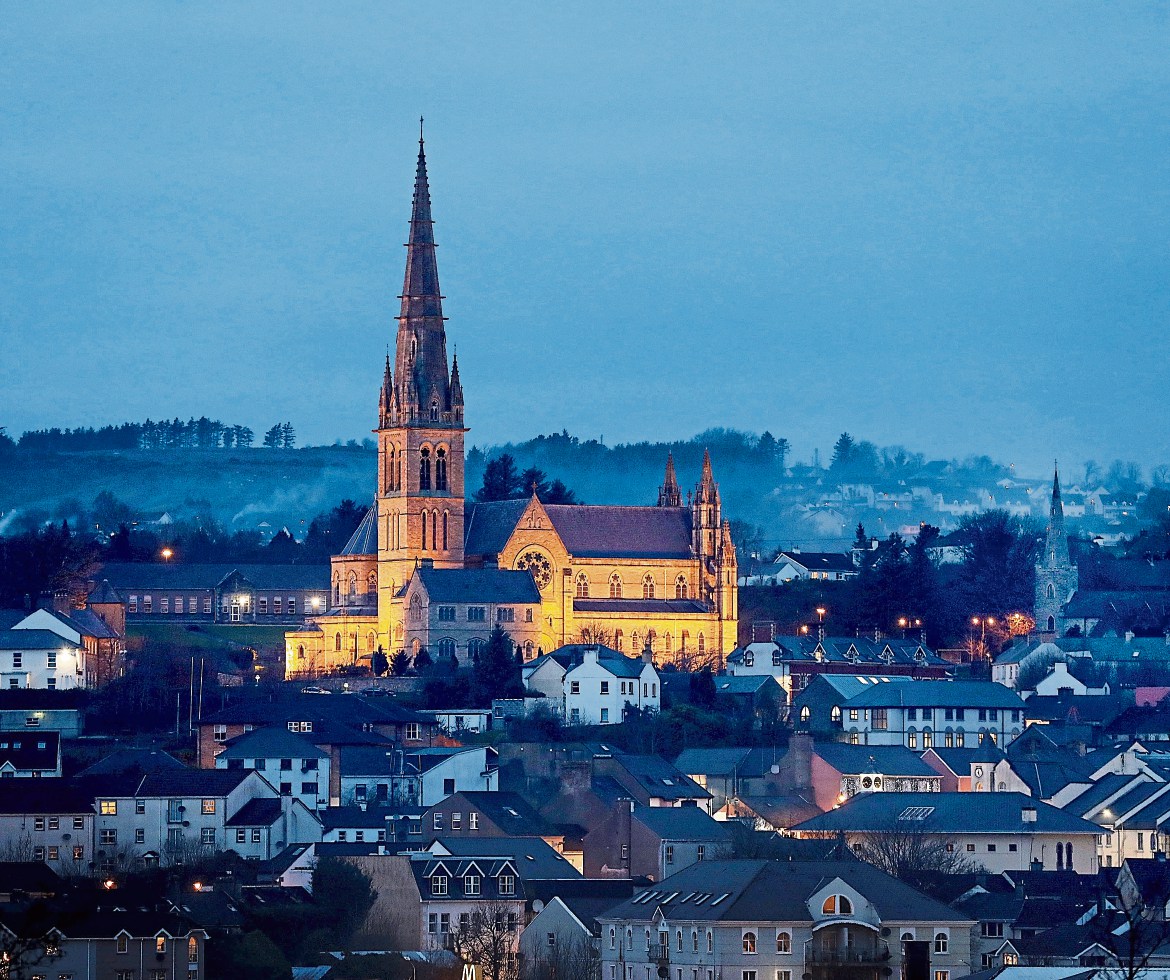
You can’t spend long in Letterkenny without coming across the name of the town’s patron saint, Eunan (or Adomnán). But it’s probably fair to say we’re a bit vague these days on who he was and what he did. But in his day he was more than just a local figure, being a highly influential abbot, scholar, and diplomat. He is somewhat overshadowed by St Colmcille (or Columba), but he’s a significant figure in his own right, worth looking at now on the Cathedral’s 125th anniversary.
Eunan was born around 624 CE, probably at Drumholm near Ballyshannon, a descendant of the same powerful Uí Néill dynasty from which St Colmcille came. His father was Rónán mac Tinne and his mother Ronat; his grandfather Tinne was a cousin of Colmcille (and was part of the first voyage to Iona). Eunan followed Colmcille into monastic life at a young age, eventually joining the monastery Colmcille had famously founded on the island of Iona.
He was elected the ninth abbot there in 679, becoming the highly-educated head of a monastic network spanning Ireland, Scotland, and northern parts of England (he probably spent a few years teaching and studying at Durrow too).
St Eunan, with no actual links to the town, became associated with Letterkenny when the Catholic Bishop of Raphoe officially changed residence in the eighteenth century. Prior to this, he had been associated with the overall Diocese of Raphoe (he founded the first cathedral in Raphoe), but when, in 1782, Bishop Anthony Coyle took up residence in the parish of Conwal (in the Ballymacool area), he brought the saint’s name with him. When the Cathedral was later built in Letterkenny (and the bishop moved to the Bishop’s Palace opposite it), the names of Eunan and his mentor Colmcille were applied to it.
Eunan’s tenure as abbot was marked by his diplomatic skills, scholarship, and legal reforms. He’s best known for his role as heir and biographer of St Colmcille: his most famous work, the Vita Columbae is the primary reason we have such a detailed record of Colmcille’s life, Eunan compiling information from several older sources into one historical document.
It’s both an historical account and a religious text, solidifying Colmcille’s status in Celtic Christianity; it’s the oldest surviving document about him, and one of the most influential manuscripts of early Christian literature.
Bizarrely, it is also in the Vita Columbae that Eunan includes a story of St Colmcille confronting a monster in the River Ness – the very first recorded account of what is now known as the Loch Ness Monster.
Eunan describes Colmcille making the sign of the cross and commanding the beast to “Go no further, and turn back with all speed.” (Reader, Nessie did so.)
Just as important, if less known, was another work of Eunan called The Law Of The Innocents (or Cáin Adamnáin).
At the Synod of Birr in 697, he successfully campaigned for this revolutionary law that protected non-combatants during warfare, specifically outlawing the killing, injuring, or taking captive of women, children, and clerics. The penalties for violating this law were severe, including fines and, in some cases, execution. It’s a significant law, far ahead of its time: it is considered one of the first international humanitarian laws in history, a precursor to modern concepts like the Geneva Convention, marking a radical shift in how medieval war was conducted.
The fact that Eunan was able to unite kings and church leaders from across Ireland and Scotland behind this law highlights his considerable influence, something of which perhaps we are less aware these days. A particular incident in 686 also showcased Eunan’s skills as a leader and diplomat. Two years after King Ecgfrith’s Northumbrians raided the kingdom of Brega (in present-day Meath; the raid was described by the Anglo-Saxon chronicler Bede as an “unwarranted attack on innocent Christian people”), Eunan was sent by the Brega King Fínsnechta Fledach to negotiate the release of 60 Irish captives taken during the raid. By the time Eunan arrived, Ecgfrith had been killed in battle, and his half-brother, Aldfrith, had succeeded him.
Unlike Ecgfrith, Aldfrith had a deep connection to Ireland. He had possibly spent time in exile there and was educated in Irish monastic traditions; as a man of learning he may even have been a pupil of Eunan’s, or at least, having spent some time in Iona, had some prior relationship with him.
In any event, their connection worked to everyone’s advantage. Eunan presented Aldfrith with a copy of his work, De Locis Sanctis (“On the Holy Places”), an account of a pilgrimage to the Holy Land based on the reports of the Frankish bishop Arculf. Aldfrith was so impressed that he had it copied and distributed throughout his kingdom, establishing Eunan’s reputation as a man of great learning. Not only did Eunan secure the release of the Irish captives, but Aldfrith promised to never again launch a raid on Ireland.
Bede suggests that, during his visits to the Roman-influenced Northumbria, Eunan decided it would be better if the Celtic church also adopted the ways of Rome – most significantly in the dating of Easter and the wearing of a tonsure.
His insistence on this led to Eunan becoming alienated from his resistant colleagues at Iona, and as a result he left the monastery, at least for a while. His case for adopting the practices of the Roman church had some success among Irish monks and priests, but Iona did not adopt the new practices in his lifetime (Abbot Dunchad finally made the change in 716).
Still, when St Eunan died, on the 23rd September 704, it was probably at Iona, suggesting he remained abbot there despite the earlier debates. The date is still his feast day.
He is usually said to have been buried at Iona, though his relics were likely destroyed by 9th century wars and invasions. Ten Irish and eight Scottish churches have been dedicated to him.
The Cathedral in Letterkenny, known usually as St Eunan’s, is in fact dedicated both to St Eunan and St Columba.
Of course, Columba is known locally as Colmcille – but if you look at records from a century or more ago, you will see that, even here, he was known as Columba.
The media at the time was mainly English, and saints were routinely referred to by their formal Latin names rather than Irish (or any other language); and at the time, the Catholic Church still used Latin as its formal language.
But in 1921 the saint’s 1400th anniversary was marked in Ireland: this not only came after the Gaelic Revival (which wished to “de-anglicise” names in Ireland), but coincided with the War of Independence and the launch of the Free State.
Local celebrations at the time made a point of using Colmcille. Over the next few decades, Irish schools, GAA clubs and local councils adopted it (and equivalent local saints’ Irish names) too.
Finally, following Vatican II in the 1960s, the Church also permitted the formal use of vernacular languages. So Colmcille it is.