


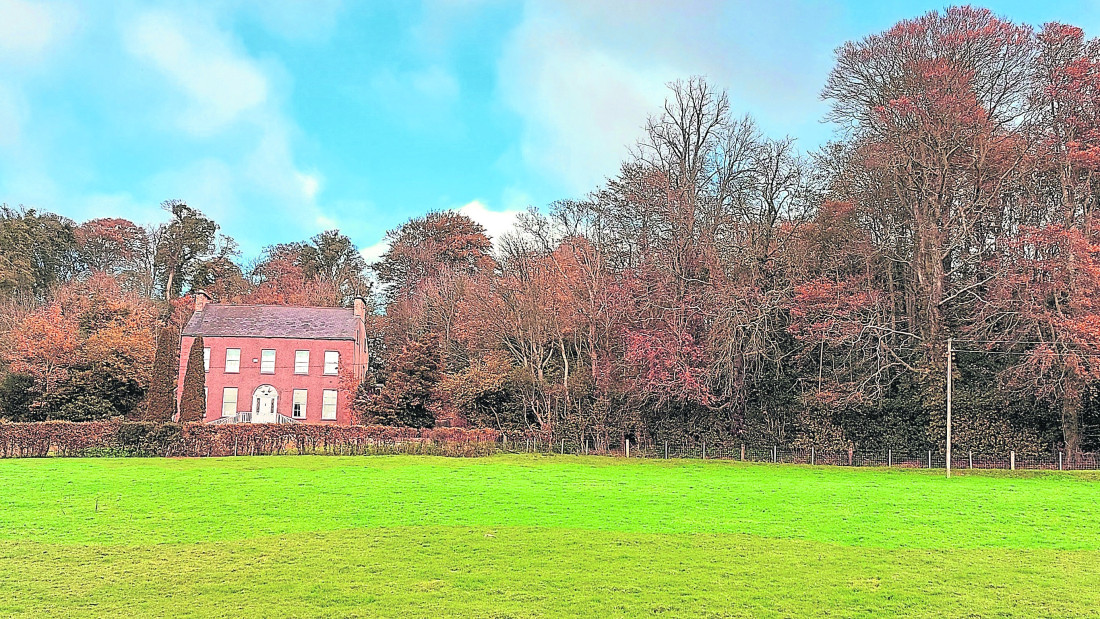


PERCHED demurely at the bottom of De Valera Road, Gortlee House was once, like a lot of older buildings, outside of town, but now merely on the outskirts of Letterkenny.
You’d notice it because of its position and the lustrous mature trees around it.
But the house itself is notable, one which would not seem out of place in a Jane Austen adaptation (aptly enough, it turns out): a late Georgian country house, fairly typical for early 19th-century Ireland, built as a five-bay two storey house, with a basement, an attic, and a quoined front face.
The current building dates from around 1800 (earliest possible dates go as far back as 1785), though there are indications that portions of an even earlier house were incorporated into it (belonging to a Major Stafford); a courtyard of outbuildings, carriage arches, and former service wings was hidden from view behind it.
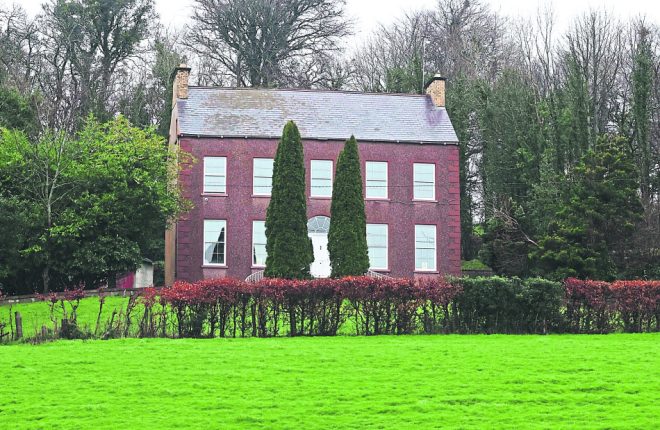
Gortlee House – a home with a fascinating history. Photo: Brian McDaid.
The famous wooded estate has been reduced in recent years, as has the former walled garden, making way for modern road development.
Before the house even existed, the land at Gortlee (the name comes from the Irish Gort Laoigh, meaning “The Calves’ Field”) was associated with the Stewart family since the years following the Williamite Wars in the late 17th century.
Charles Stewart, a loyal soldier to William III, was granted the lands at Gortlee for his great service at the Battle of the Boyne (Charles’ brother Robert was in turn the ancestor of Charles Stewart Parnell). Charles’ son Robert inherited the estate after him, but Robert’s own children, despite being born there, had little interest in it; so by the mid-18th century it had passed to the well-known Boyd family, a branch of whom also owned Ballymacool House.
Among the Gortlee Boyds, one notable figure was William Boyd: born at Gortlee in 1742, he later held important civic posts in County Donegal, such as Treasurer and customs collector at Ballyraine.
The Boyds, probably headed then by Alexander, built the house itself (or rather, rebuilt what was already there) and lived there in the early 19th century. In 1837 one J Cochran, Esq. is listed as living there, and shortly afterwards the house and estate came under the control of the Patterson family.

Sir Richard Griffith
In Griffith’s Valuation (1850s), Thomas Patterson was recorded as leasing the house, valued at £25 (and in 1876 was listed as owning 575 acres).
Like the Boyds, the Pattersons were prominent locally; Thomas Patterson’s son, Thomas William Patterson (born in 1844) had a distinguished military career, serving in conflicts like Afghanistan (1879–80) and Burma (1886–88), earning notable medals (one of which, for the Companion of the Distinguished Service Order, was presented to him by Queen Victoria herself).
CONTROVERSY
The Robinson family took over the house (and about 40 acres around it) in the 1880s, and have owned it since then. In fact the property has been the focus of some controversy lately, as development plans have been met with local resistance. In 2009, a planning application was lodged for the 40 acre estate, envisioning a large mixed development (including residential units, a hotel, offices, retail, and an extension to the town park), permission for which was granted in 2010 by the Town Council but modified in 2011 by An Bord Pleanála following objections.
The work was never carried out but, partly as the lingering fallout from that (and the destruction of some of the native woodland around the house), in 2022 local campaigners renewed efforts to have Gortlee House formally listed as a protected structure.
One of the most intriguing parts of Gortlee House’s social history is its association with Jane Austen, through her niece Cassandra Knight, who married Lord George Hill (who owned 23,000 acres in Gaoth Dobhair) in 1834.
It’s likely that the Hills briefly owned Gortlee House as their first home in Donegal, before moving to their long-term home at Ballyarr House near Ramelton.
Their daughter Cassandra Jane Louisa Hill was born there in March 1842. According to the announcement in the Londonderry Sentinel “At Gortlee, on Saturday morning, 12th inst., the Lady George Hill, of a daughter.”
In fact they had three other children, but it’s not completely clear from contemporary sources where they were born: only Cassandra Jane was certainly born at Gortlee). Cassandra, the mother, died of puerperal fever just three days later (she is buried in the Church of Ireland graveyard in Letterkenny).
Griffith’s Valuation is the common name for what was, formally, the Primary Valuation of Ireland, a property tax survey carried out under the supervision of surveyor and geologist Sir Richard Griffith (1784 – 1878).
If the name means nothing to us, Griffith’s decisions still quietly affect us: in 1824 Griffith was made Boundary Commissioner, overseeing the precise fixing of (often disputed or uncertain) property boundaries. In his mapping he also generally used anglicised placenames, which means he continues to impact the shapes and names of today’s maps and places.
The Valuation was the first full valuation of all property and land in Ireland, conducted between 1847 and 1864 for taxation purposes. It was compiled to determine how much “Poor Law tax” each landowner and occupier should pay to support local workhouses under the Irish Poor Law Acts.
The system, with occasional modifications, actually remained in place until the 1970s, but it did not start well: where tenants had an income valued at under £5 annually, it was the landlords who had to pay the tax. This probably seemed reasonable in the beginning, but it provoked landlords into getting rid of small tenants, contributing hugely to the wave of evictions of the late nineteenth century.
The Valuation included details about the names of occupiers and landlords, descriptions of the property and associated lands, and a valuation. It remains important today: there are no complete surviving census data between 1821–1891, so Griffith’s Valuation is perhaps the most valuable resource for family history research in the 19th century.
This Hidden from View feature was written by Paul Bradley.