


By Paul Bradley
As much as ruins can be fascinating things in their own right, it’s a shame to see Ballymacool House, once the centre of a wide estate, in its current state of disrepair. But it still has a good story to tell, going back to 1783 when John Boyd, founder of the Ballymacool dynasty, purchased the estate (and the smaller 1770s house that existed there at the time) from a Bristol merchant named Samuel Span for £3,000. That was a colossal sum at the time, underscoring not only the family’s existing wealth (the Boyds were a branch of the Scottish Earls of Kilmarnock) but their commitment to the Letterkenny area.
John Boyd was, as well as being a landowner, a man of influence and military distinction. He was a local magistrate who served as High Sheriff of Donegal and held the rank of Major in the Donegal Militia. His 1766 marriage to Martha, the daughter of a Colonel Stewart (Governor of the Bahamas), further cemented his family’s high social standing.
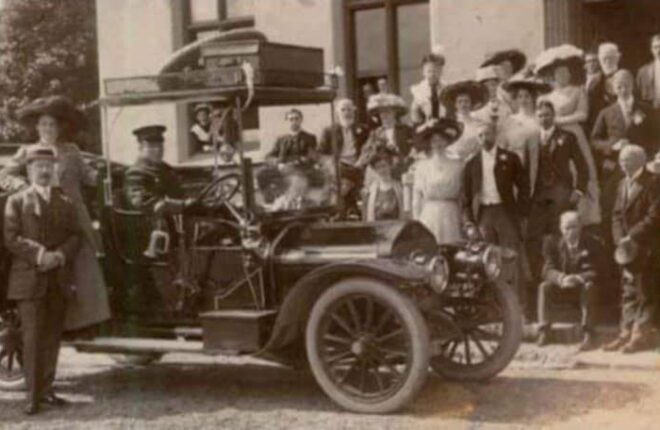
Boyds of Ballymacool, around 1920.
The house itself was initially built around 1770 in Georgian style, using local stone reportedly sourced from the same local quarry that would later supply the materials for St Eunan’s Cathedral in Letterkenny a century later. Around 1830 the original house was largely rebuilt and refaced in the Tudor Revival style popular among the Anglo-Irish gentry at the time, with steep gables, oriel window and mullioned casement windows, and a new third floor. There were also extensive grounds, including a renowned pine walk featuring a variety of rare conifers considered some of the finest in Ireland. There were also walled gardens, orchards, and a schoolhouse for the local children.
Though the architect is not clear, it’s usually believed to have been John Hargrave, who also worked on Rockhill House around the same period; in his 1979 guide to the architecture of North West Ulster, Professor of Architectural History Alistair Rowan sniffed that “The interior detail, all rather gross, suggests John Hargrave as the architect of this transmogrification.” Tastes differ, of course: Hargrave was well-known for his “grand house” work, and also designed the Courthouses in Omagh and Mullingar (said to be one of the finest in Ireland).
The Boyd family’s tenure at Ballymacool was marked by prosperity and occasional controversy, particularly when the estate passed to John’s grandson, John Robert Boyd, a barrister known for arrogant ambition (he was also High Sheriff of County Donegal during the height of the Famine); a report in the Londonderry Journal in February 1870 described him being “hooted on two occasions” by a crowd during a major Tenant Rights meeting in Letterkenny. Nevertheless, by the mid-19th century, Ballymacool had become a familiar symbol of Boyd authority, and it was the same John Robert Boyd who funded the town clock you can see in old photos of Letterkenny’s Market Square, which ticked away until the mid-20th century.
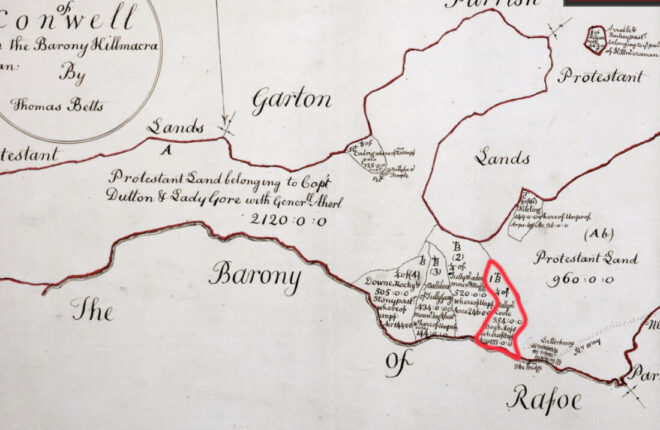
Down Survey 1656, showing the estate (note the Oldtown Bridge nearby).
Ballymacool’s most dramatic chapter came in the early years of the Irish state. In 1922, during the War of Independence, anti-Treaty forces seized the house and evicted the then-tenant Major Brett (the Resident Magistrate for the Letterkenny district). During the occupation, a priceless silver salver—reportedly a 15th-century wedding gift to Thomas Boyd, Earl of Arran, on his marriage to the daughter of King James II of Scotland – was stolen. Though there were later ransom demands by anonymous letter writers, the piece was never recovered.
A month later, in July 1922, pro-Treaty troops launched a coordinated attack on Ballymacool and nearby Rockhill House. The house was retaken, but not before the intruders allegedly disturbed family graves in search of hidden weapons. Today, a revolver said to have been used in the assault is on display in the Donegal County Museum.
During the 1930s, Ballymacool’s gardens were described by the Weekly Irish Times as “among the finest in the country.” But the family’s fortunes were in steep decline, and the emigration of younger generations left the house without a true inheritor. Around 1941 the estate was sold to the Kelly family for under £2,000—a fraction of its former worth (remember, it had cost £3,000 in 1785). The gardens were felled for timber, the arboretum lost forever.
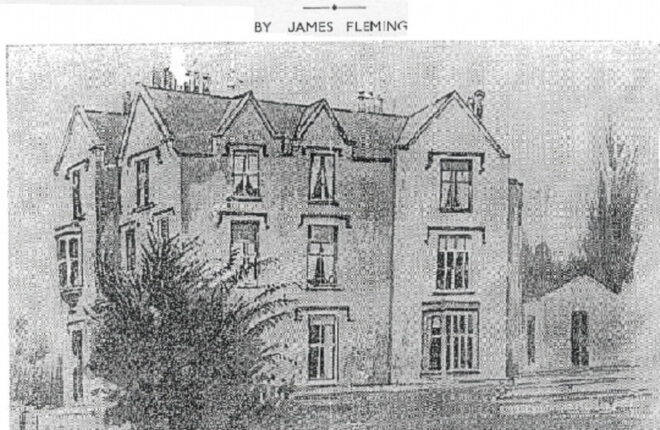
Ballymacool House featured in the Irish Times in 1940 for a feature on historic Irish mansions.
The house passed out of the Kelly family’s hands in the 1980s, and since 2000, the estate has been progressively sold off in lots to developers. Despite efforts by local conservationists to save and restore the house as a heritage centre, this has yet to happen, even as the town expands around it and modern houses stand where the trees once were. In 2009, Letterkenny Town Council opened Ballymacool Park, a €3.8 million, 20-acre public amenity built on a portion of the former estate. But the house itself remains a roofless shell, suspended between grandeur and gravity.
The historic house has attracted its share of myths and rumours
As ever with big houses – in particular one falling into ruin – Ballymacool House has attracted its share of myths and rumours, some of which are closer to the truth than others.
One of the most persistent is the old tale of a secret tunnel said to connect Ballymacool House to Rockhill House across the river. This would have provided a means of escape or secret communication for the gentry in times of unrest. In reality, neither historical records, nor more recent architectural appraisals, nor even the experiences of the opposing sides who seized it during the Civil War, support the idea. And given the distance between the two houses, and the fact it would need to pass under the river, it would have been a difficult bit of engineering to begin with.
More appealing, but no more convincing, were the occasional old stories of ghostly “ladies in white gowns walking the upper floors” years after the house was abandoned.
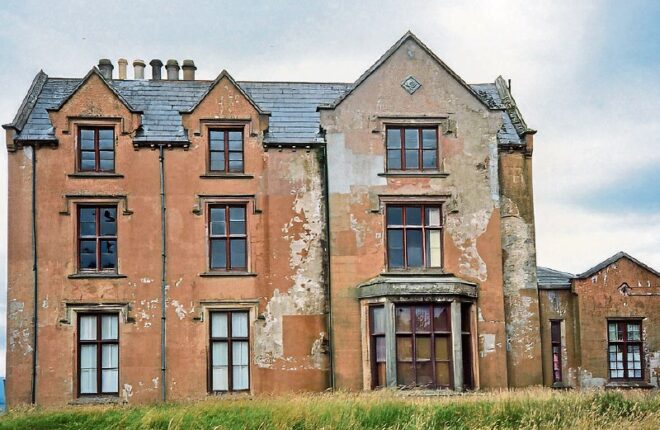
Ballymacool House pictured in the 1990s.
A true story links the Boyds of Ballymacool to the world of rock, and furthermore, roll. If you follow the lineage down through Major John Boyd’s fifth son Archibald, you eventually arrive at Pattie Boyd, born in 1944. If the name means nothing, she was an English model and, famously, a muse and wife to both George Harrison and Eric Clapton. She is the inspiration behind Harrison’s “Something”, as well as Clapton’s somewhat boorish “Wonderful Tonight” and “Layla”.
One final story, and a more personal one: as a young child I believed Ballymacool House was where Santa lived. However, I must admit that evidence supporting this claim has yet to materialise.