




By Paul Bradley
There was an expression when I was growing up, used to show you that you weren’t just wrong but laughably so: “you’re as far out as Fanad Lighthouse”.
Fair enough. In fact Fanad (Head) Lighthouse is positioned at 55°16.575′ North, 07°37.921′ West: which, as an indication of wrongness tells me nothing, but helps explain why the lighthouse is classified as a sea light, marking the entrance to Lough Swilly from the Atlantic.
Fanad Lighthouse began as a decisive response to tragedy: specifically the loss of the HMS Saldanha in 1811. The Saldanha was a Royal Navy frigate commissioned in 1810, stationed in Ireland to help enforce the ongoing naval blockade against Napoleonic France.

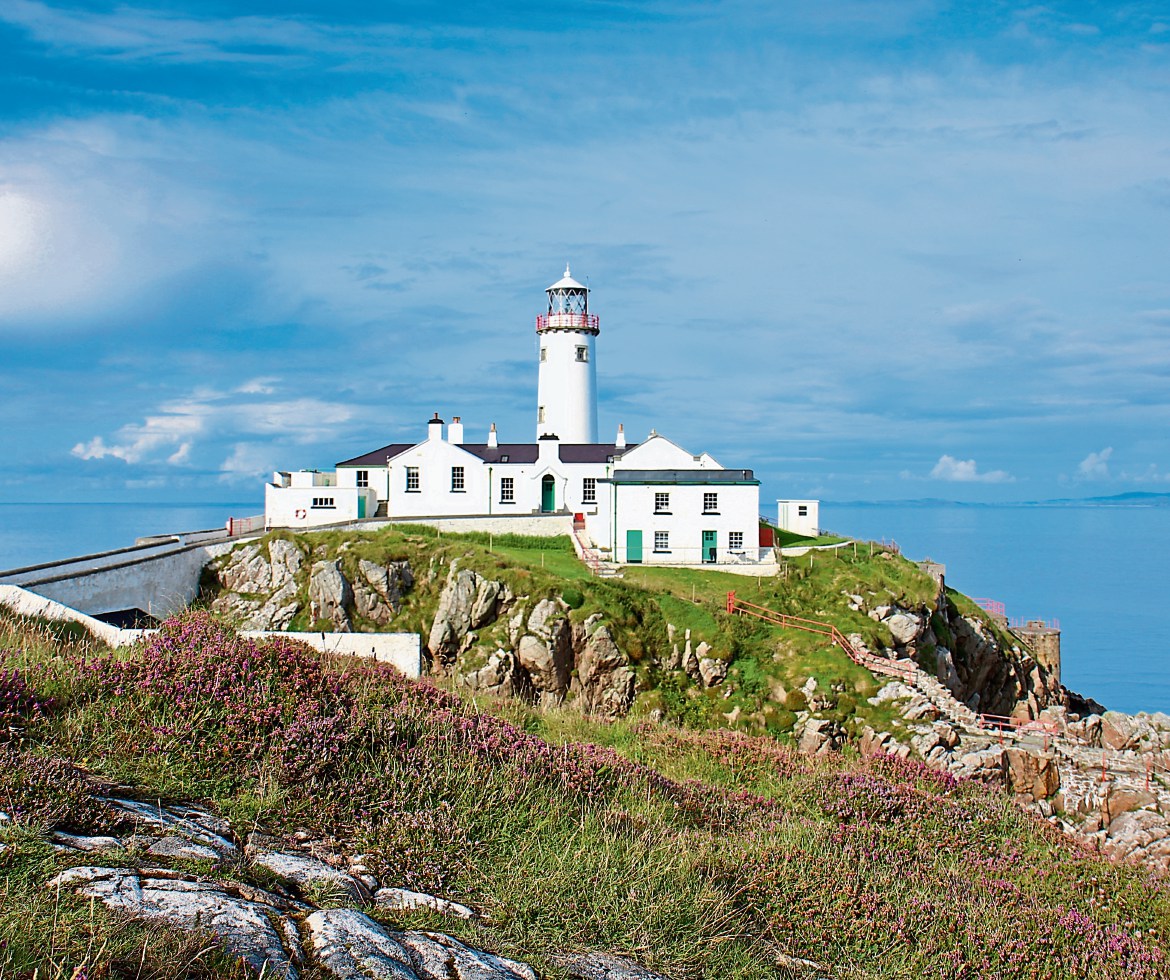
Fanad Lighthouse
Sailing just off Lough Swilly on the evening of December 4, 1811, she was caught in a violent storm, and although the crew sought shelter in the Lough, she struck rocks at Carraig Dhónaill. The impact was violent enough to break some of the heavy guns loose below deck, causing havoc even before the ship was lost in Ballymastocker Bay.
Over 250 people died in the wreck, including the young Captain William Pakenham. It’s said that the only survivor was the ship’s parrot, which was shot by a farmer in Burt a few months later, and was wearing a silver collar inscribed with the words “Captain Pakenham of His Majesty’s ship Saldanha”.
Immediately after hearing the news, Captain Hill of the Royal Navy in Derry, something of an expert on that stretch of coast, wrote to the Ballast Board, arguing that a light was needed at what was then called Fannet Point. They approved the request without delay, and sanction was then granted by Trinity House (the London-based authority who oversaw Irish Lights operations at the time) in July 1814.
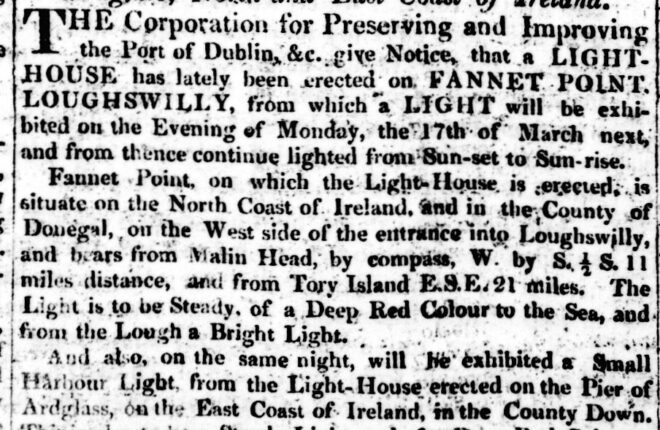
The Dublin Evening Post of March 13, 1817 announcing the lighting of Fanad Lighthouse.
Work began in 1815, with a budget of £2,000. It was overseen by George Halpin, a prominent civil engineer of the era, and the Ballast Board’s Inspector of Works and Inspector of Lighthouses.
For speed’s sake, Halpin opted for a modest tower, with a small interior diameter of 5 feet 9 inches, three stories high (ground, first, and lantern) – it suited their needs at the time, but did mean it needed costly structural work later in the century when larger optical systems were required.
The light was first lit on St Patrick’s Day 1817. The initial system relied on reflectors, an older technology requiring continuous manual operation; the light came from nine sperm oil wick lamps. The light was fixed (non-flashing) and was visible for 14 miles in clear weather, showing red toward the open Atlantic Ocean to warn of the external hazards, and white towards Lough Swilly, indicating the entrance to the safe harbour.
By the mid-19th century, oil-and-reflector technology had been superseded by the lens-based systems developed by Augustin-Jean Fresnel. So in March 1871 the Duke of Abercorn (and numerous signatories) requested modernisation, and in 1872 Trinity House agreed to a conversion to a fixed lens with an integrated red sector to warn about the dangerous Swilly rocks.
Without the urgency of a possible invasion, this became a bureaucratic slog lasting several years. Estimates were submitted in 1875, but debates rolled on about suitable optics and fuel (there was concern that a move away from oil to gas would mean the costly construction of an on-site gas works).
In the end Trinity House suggested recycling the old lens from Tory Island—which was itself being upgraded— into a new tower at Fanad. Eventually the new lights, on the new tower, went into operation on September 1, 1886 (traces of the old stone tower are still nearby).
Throughout the manual operation era, the station required resident staff: a Principal Keeper and an Assistant Keeper, along with their families, and often, in winter, a Supernumerary (a third keeper). As systems were upgraded and automated over the years, the need for resident keepers diminished. The last principal keeper retired in 1983.
The lighthouse has witnessed its fair share of history. The waters surrounding it were often dangerous, an area of ongoing strategic importance during WWI and WWII.
There are dozens of wrecks in the vicinity, including: the battleship HMS Audacious, sunk by a German mine and lost in October 1914 (the 900-strong crew was saved); the SS Laurentic (1917), sunk by a mine in January 1917, losing 354 lives and 3,211 gold ingots; and numerous private or commercial craft and German U-boats.
It was also involved in a unique War Of Independence incident when, on September 4, 1920, it was raided by four members of the IRA’s 1st Northern Division (the IRA across Ireland had targeted lighthouses for their explosive fog-signal charges, which could be repurposed for road mines). In all but one of these raids, keepers were allowed to continue operating the light. The sole exception was Fanad Head, where the keeper was ordered to turn off the light while the IRA raiders attacked the Coastguard Station nearby (these were attacked as British apparatuses, unlike the lighthouses themselves), and the raiders held him at gunpoint to prevent him from turning it back on.
These days, while still operating as a sea light and an Automatic Identification base (helping to track and identify vessels in the area) Fanad Lighthouse is also a sight to see.
It’s been voted one of the world’s most beautiful lighthouses, and its mainland position along some wild coastline makes it a major draw for travellers (some of whom stay in the converted keepers’ quarters; most climb the 76 steps to the top).
The Hidden from View column is written by Paul Bradley.
This year marks the tenth anniversary of Fanad Lighthouse as a visitor experience open to the public.
Fanad Lighthouse which is perched on the edge of the Atlantic Ocean.