




By Paul Bradley
These days walking through the gates of Old Leck in Letterkenny is like stepping back in time, in more ways than one.
Of course there’s the sense of weathered peace that you find in cemeteries all across Ireland. But for people of my advanced age, at least from the vicinity, it was also a place where you might go on a dim wintry evening to test your bravery: old, crumbling, close to the Swilly, it was the kind of place where, you know, you might come face-to-face with a ghost.
But if it seems like a minor spot on the outskirts of Letterkenny, don’t let that fool you: long before the town ever existed, it was one of several important monastic sites in the area.
In fact Letterkenny was built at the point where three such religious settlements met: the triangle of Leck (“the flat rock”), Conwal (“the Ecclesiastical settlement”), and Aughaninshin (“The field of the Ash Trees”), each of which was important a few centuries ago.
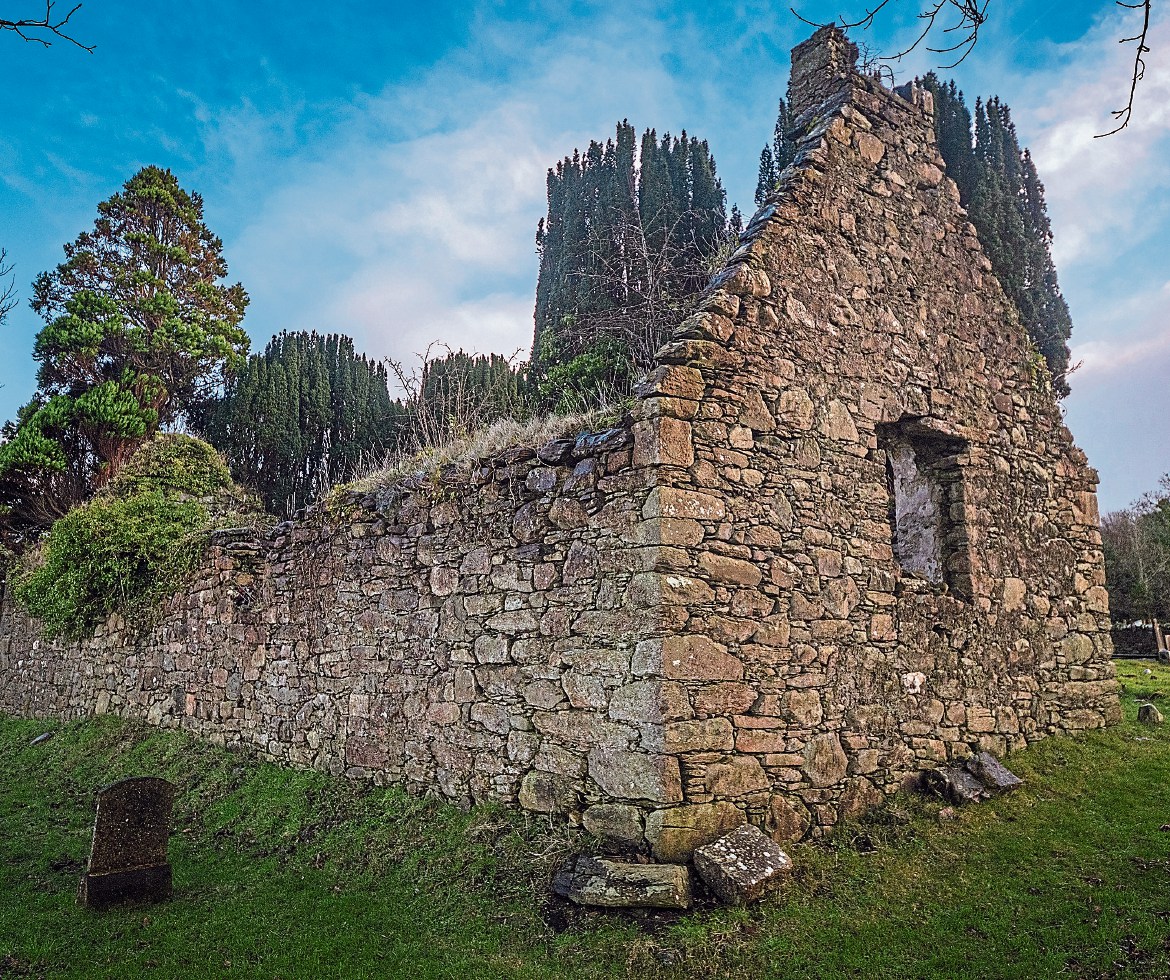
Old Leck graveyard is roughly rectangular, enclosed by low rubble stone walls. Its centrepiece is the ruin of the old church, which was built around the year 1500.
The church started life as a Catholic place of worship before being converted (probably around 1622) for the Church of Ireland in the 17th and 18th centuries. It was repaired and enlarged, and the windows probably expanded, between 1729 and 1733, after which it served as a church for both local Catholics and Protestants.
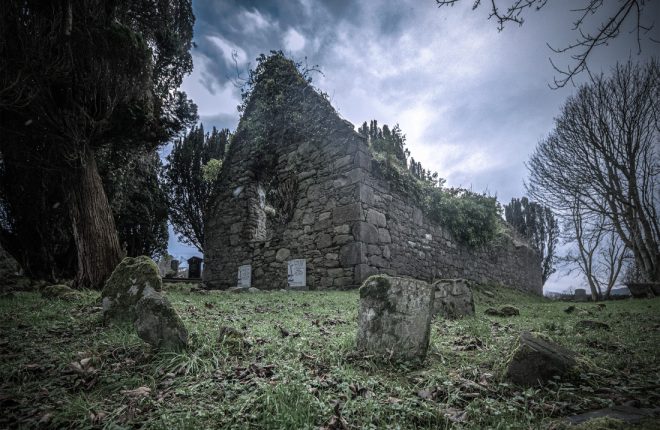
It eventually fell into disuse in the mid-19th century when shifting population patterns led to the amalgamation of smaller outlying churches.
In 1872, the parish of Leck was formally joined with Conwal, making Conwal Parish Church the primary place of worship for the entire Church of Ireland district.
Many of the gravestones, or at least the ones still legible, date from around this time or shortly before.
You will find the grave of Rev Haughey, a local rector whose grave dates back to 1797, or the Rev John Chambers, who served the church for 58 years before his death in 1835.
More recent ones include the ancestors and family of people still living in and around Letterkenny and the Oldtown area; there’s a well-maintained monument for the Campbell family, for example, dated as recently as 1991.
A medieval cross-inscribed slab is built into the church masonry, which suggests the site may have had an even earlier sacred use, with carved stones being re-used from an older church.
Of course that is not uncommon with religious sites, with churches often built on old churches themselves often built on pre-Christian religious sites.
And there is in fact a holy well dedicated to St Brigid just outside the east wall, older than the church structure and ultimately a remnant of pre-Christian devotional customs (still in some use, often to get rid of warts).
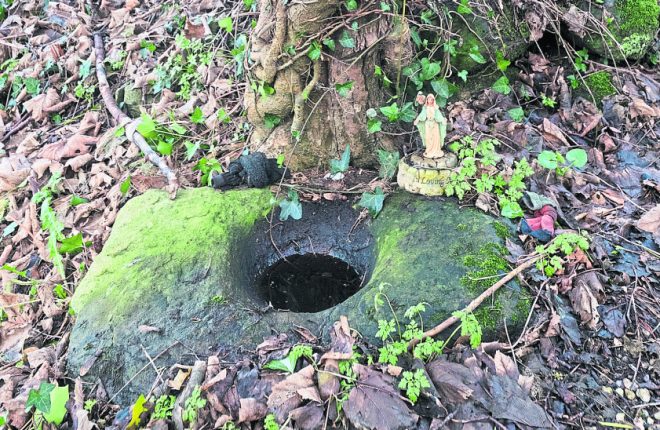
The holy well which is still in some use, often by people who want to get rid of warts.
Of course, as a town grows its needs grow too. Just a short walk from Old Leck is New Leck, which officially dates from 1978 but was in use for years before that (the site was purchased by the Letterkenny Town Commissioners in 1897 as a non-denominational cemetery). But it was used by St Conal’s, so it was not considered a public cemetery until the parish and local authorities began to plan its rededication in the 1970s.
Before then, burials were not always marked with headstones, but a memorial service was held in 2020 to remember those buried there between 1902 and 1980.
But the population continues to grow, and local authorities have been discussing the need for a new municipal graveyard again: it’s possible that New Leck may be extended into the county’s first municipal cemetery.
The name ‘Leck’ comes from the Irish ‘leac’, which literally means a ‘flat stone’ or rocky surface. It’s not entirely clear what this refers to in Leck’s case. Some people think it relates to a medieval carved stone in the body of the church, but it’s more likely that it refers to the wider area, which was simply a stony outcrop suitable for building on.
Certainly in a placename context ‘An Leac’ usually indicates a prominent shelf of stone, often found near a river or a hillside (the Swilly in this case). 19th century Ordnance Surveys refer to the cemetery area as “a level rocky surface”.
See more Hidden From View features: https://donegalnews.com/hidden-from-view-the-fascinating-history-of-gortlee-house/
Old Leck
Whole decades have decayed since I first came,
One of that year’s boys seeking the chill
Of trees whispering to moss-green graves, whose names
Time had taxed from the crooked stones. I come
Again now, unbelieving, up this hill,
To a past all boys believe they’ve broken from.
It’s far less ancient now. Brown marble, stacked
Against what little church walls still remain,
Speaks of hands still warm, of life’s long pact
With loss. The looming ruins have grown small.
They’ve knocked the sunken shack that topped the lane
(No banshee kept her rooms there after all).
But even now a blackbird nests and sings
High in a yew whose creaking limbs once shook
The brass out of our bluster, and memory springs
Unbidden ghosts around me. In these shattered
Stones I sense the long dead’s faint rebuke,
And boyhood’s end, and friendships dead and scattered.
I stand at the northern wall and, squinting down
Through farms and time, I feel the dead years’ wake.
The Cathedral still dominates the town,
And though the marsh below’s now drained and sealed,
The sullen Swilly is still the sunning snake
Lazily looping its coils on childhood’s fields.
I salute them all, for all wishes are worth,
And stand, with the last of a cool sun on my face,
By lichen-dappled stone in the patient earth,
Among melting names, and old silence deeply grassed.
And, breathing the living air of this dying place,
I too am growing closer to the past.