


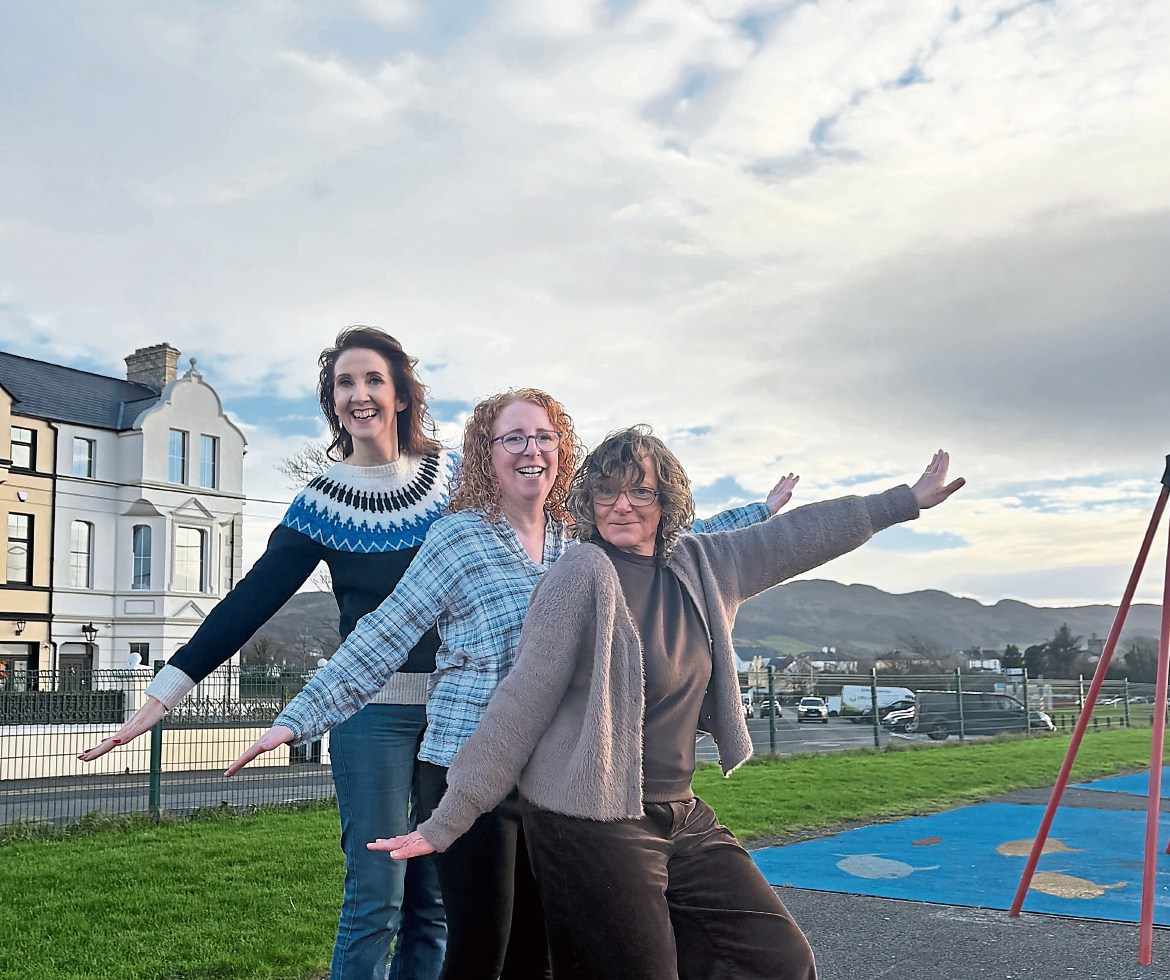


Hi Avril, how are things with you? Could you tell us a bit about yourself please?
I’m originally from Gortahork and still regularly visit my mum and dad, my sister Martina, my brother Gerard and his family, so I’m regularly on the road.
I moved to Redcastle 25 years ago, and we love it. We’ve been lucky to make so many lifelong friends since we moved here. We also have the gorgeous shore path on our doorstep, which I have to admit I don’t get to walk on often enough.
How did you come to be a Play Therapist?
I qualified as a teacher in 1992 and worked in mainstream education before moving into the Home School Community Liaison role for five years in Bridgend and St Johnston.
There I heard first-hand from parents about the struggles their children were facing – anxiety, challenges with friendships, and just the pressures of being a child in today’s world. I then moved into special education and saw for myself how many children were finding it hard to fully engage in learning due to those many pressures. That’s when I began reading about play therapy, and I’ve been absorbed by it ever since.
I trained with NUI Galway, where on my first day I met two fellow students from Derry, Cathy and Joanne. I was drawn to the familiar ‘wee’ accents. We clicked immediately and throughout our training we often talked about opening a practice together. As luck would have it, the very day we began looking for a premises, the offices we now work from in Elaghbeg Business Park in Bridgend came onto the rental market; we took that as a sign, and Inspire Play Therapy was born.
It’s been challenging at times starting a new business, and I was so new to the social media side, poor Joanne had her work cut out trying to teach me and Cathy how to use Instagram. We still ask “is this a post or a story!”
What does ‘Play Therapist’ mean exactly? Is there an age at which it gives way to other methods?
Play therapy is a child-centred approach that supports emotional growth and healing through play rather than traditional talk-based counselling.
It’s based on the idea that play is their natural language and toys are their words.
Unlike ordinary play, which is mainly for fun and exploration, play therapy takes place with a trained play therapist who understands the meaning behind children’s play and uses it to help them express feelings, work through experiences, and develop coping skills.
Most children under 13 are still learning to understand and verbalise their emotions, so are often not ready for talk therapy, which relies on adult-style thinking and language.
The essence of it is that Play Therapy meets children where they are, when they don’t yet have the words to explain what they’re going through.
You have said that even children are suffering greater anxiety these days. What might be causing that (particularly with younger children)?
I think we’re seeing children today growing up in a world that feels more pressured and fast-paced than ever, and even very young children are picking up on that.
Families are juggling busy schedules and financial pressures. Children are incredibly tuned in to the emotional atmosphere around them.
We’re also seeing the impact of things like the aftermath of Covid, increased screen time, and reduced opportunities for play, which is how children naturally process their feelings and experiences.
For some children, there’s also more awareness of world events; even if children don’t fully understand what’s going on, they sense the anxiety of adults around them.
Younger children aren’t immune; they just show stress differently. Instead of saying “I’m anxious,” they might become clingier, have trouble sleeping, act out, or present with school avoidance. So, while their stressors may be different, children are definitely feeling the ripple effects of the world we’re all living in.
I am so glad that I grew up in the time I did, no phones, no social media, evenings outside playing with siblings and friends until hunger took us home. That freedom doesn’t exist for children now.
Do parents come to you before or after they have tried other avenues?
Some come to us after trying other supports, others come even before speaking to anyone else, because they sense their child is struggling and want to act quickly.
There are established therapeutic approaches for children, but many rely on talking, and younger children often just aren’t ready for that. That’s why play therapy can be such a good fit.
We have been amazed by the number of parents who have reached out for support, and if play therapy isn’t right for a child at that time, we are happy to point families in the right direction and offer guidance on what might be more appropriate.
Do parents let you know when they see a change in their child after attending? Are they actively involved?
Parents regularly tell us about changes they have seen at home or at school. It’s often small things that mean the most: better sleep, fewer meltdowns, improved confidence, or a child who can talk about their feelings a little more.
Progress can be gradual, but parents are usually the first to notice. While the therapy sessions themselves are one-to-one with the child, parents are very much part of the process.
Parents know their child best, so their involvement is not only welcomed, it’s an essential part of the therapeutic journey.
If we’re creating a generation of people stressed from early childhood, surely something major needs to change in society?
Yes, children today are experiencing higher levels of stress earlier in life, and that tells us something in society needs to shift. But at the same time, we are talking about children’s mental health far more openly than ever before.
Parents are seeking support earlier, schools are more aware of emotional wellbeing, and services like play therapy are growing because people recognise that children need emotional support as much as academic support.
The New Relate programme introduced in schools is also a positive step forward, and in the school I work in (St Baithin’s in St. Johnston), my colleague Aoife has trained as a nurture teacher and the school now has a beautiful calming nurture room called ‘The Snug’.
This would have been unheard of when I started teaching years ago, as the academic was the
priority.
What do you do to tackle your own stresses?
Like everyone, I have to look after myself, because the work can be emotionally intense.
For me, time with family and friends is a big help. I love meeting for a coffee and a walk, although often we do more talking about walking while sitting in the coffee shop!
I also love to travel, and recently we went to Japan to meet my brother Patrick and celebrate his 50th, which was amazing.
Time with my own family is really important to me too. My son Jack lives in Germany, so it’s lovely when he comes home and we can all hang out together.
Those are the things that help me switch off and stay balanced.
Anything else you’d like to add?
As part of our first birthday celebrations for Inspire Play therapy we have invited schools in Donegal and Derry to join our #PreciousPlay campaign where children for one day swap homework for play. When schools accept our invitation we send a Resource pack with lots of ideas and suggestions, and it has been encouraging to see schools sign up.
If anyone else would like to take part in this interview, to raise a profile or an issue, please contact Paul at Dnthirddegree@gmail.com