


By Paddy Walsh
His grandmother’s cottage near Mountcharles still stands – a monument to memory.
Memories of relatively happy childhood days there in stark contrast to the savage hell of domestic violence, drunkenness and financial upheaval that forced him to leave London.
For the young James Harvey and his sibling, Ted, the healing heaven of Doorin in their native Donegal was a life far removed from the trauma and turmoil of their time in St. John’s Wood in the English capital in the early 1950’s.
“The truth is, if life in Belgrave Gardens had stolen our childhood, Donegal restored it.
“If 29 Belgrave Gardens had become the morgue in which our dreams came to die, the small and safe community we found in Doorin was the intensive care unit that breathed new life into both of us,” James writes in his engrossing memoir, ‘Grappling with Ghosts’.
He had not been present when his father made his most serious assault on his mother.
“But I saw the results later. Head bandaged, Jaw swollen. Eyes blackened. She was sitting in a chair in our dingy little kitchen in St. John’s Wood, with its discoloured lino curled up in the corners, while paint peeled off the ceiling and wallpaper off the walls.”
Going over the events of the day over a cup of tea with her downstairs neighbour, Vi Lyons, her sympathetic ally.
“Vi was a tiny, pert little Cockney woman, married to a man named Jack Kelsey. She and Kelsey, living in the flat below us, knew everything that was going on in our family. The fights and the screams and the beatings echoed down the stairs and through the floorboards to them below.”
And when the young James started to cry upon seeing his mother’s bandaged head, she had reached out and pulled him up on her knees. “It’s all right, pet. Sure it’s nothing. Mommy’s all right.”
But she and the family circumstances were far from all right.
“The beating she’d endured was just one of the ugly events that came to define ordinary day-to-day life in London for the Harvey family after our 1948 arrival in London from Ireland. Drunken rampages. Brawls after midnight. London bobbies appearing in the flat at all hours of the day and night. It was not a ‘Mary Poppins’ childhood,” James relates.
It was after one of those post midnight visits by the bobbies that the children, including James and his siblings, Ted, Frank, Rosemary and Kathleen were bundled into two police cars under the supervision of a Child Protective Services agent, and transported from Belgrave Gardens to an orphanage.
“When I was seven, the family fell apart so I, and my brother, Ted, were sent back to Donegal to live with my grandmother and we stayed with her for two years.”
And from the relentless roar of London traffic they came to know virtual silence in Doorin and the surrounding countryside.
“There were only three cars in the area and it was an event for a while to hear them coming and to watch them pass.”
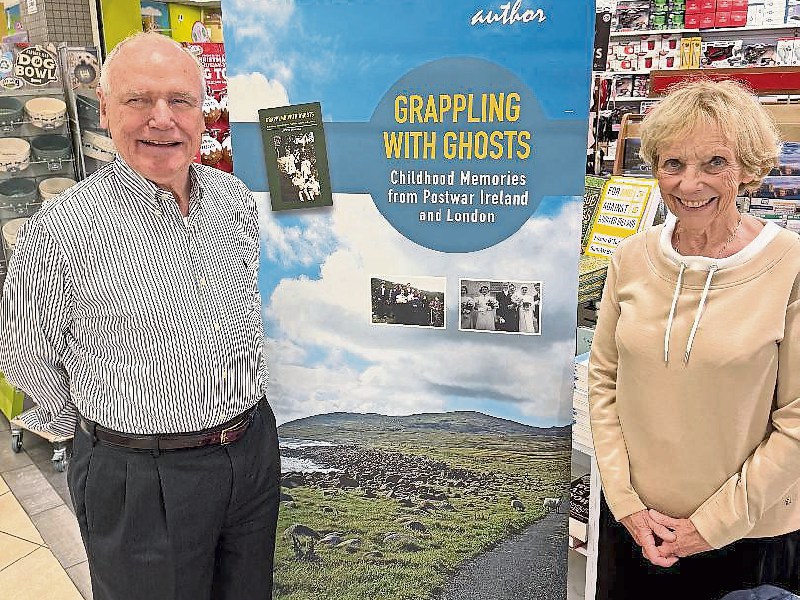
Author James Harvey pictured with his wife Ann Paxton at the signing of his book, ‘Grappling with Ghosts’ in the Bookmark store at Letterkenny Shopping Centre.
James recalls the owners of the trio of vehicles, Francie Meehan from Cannon’s Crossroads, who drove around in a dark Morris Minor. “A man in Donegal Town, I think his name was McLaughlin, owned a black Austen. The local Protestant pastor, living near Inver Bridge, owned a third car of unknown provenance.”
The Donegal they returned to in 1951 hadn’t changed, literally, remotely from the one the young Harvey and his family had left some years previously,
“To say that it was isolated doesn’t begin to capture how off-the-grid it was. It was almost a third state on this little island; outside Dublin, Ireland was rural, poverty-stricken, misogynistic, priest-ridden in Joyce’s damning term, and midway through being devoured by yet another great emigration tragedy.”
Harvey devotes much of a chapter to the influence of the Catholic church in Ireland though devotion is hardly the term to describe his opinions of it.
“It’s hard to capture today what a dark and hope-choking enterprise the Catholic church in Ireland really was for most of the 20th century. Too frequently the good works of local priests were overshadowed by what a pious and hypocritical fraud too much of the church hierarchy had become,” he notes.
But that return to his native soil brought him and his sibling the joys of childhood – the play yard of countless activities and experiences.
In an area where football and hurling was rare, unlike much of the rest of the county, the simple actions of using a stick to propel a bicycle wheel rim as they ran alongside it made for endless innocent fun. And with cows to be milked and other farm duties to be performed in the summer months they were never short of activity. Snow in the winter added another element to their play days.
The boys’ uncle Jim hitched the horse, McKeown, to a home made sleigh and off they went. “It was magic. Ted and I practically hugged ourselves with glee. At the quay, McKeown negotiated the 90-degree left that turned us away from the grey ocean. We ignored the road towards lower Doorin and went straight towards a dead end at Muntereese, where Auntie Kitty lived.
“Then it was left to the Doorin Line, left again to the line down to Cassidy’s store, where we took another left bringing us down past Cannon’s Crossroads to Granny’s cottage. The entire countryside was hidden by a glistening veil of white.”
Further adventures and misadventures followed but, of course, it wasn’t all fun and games. There was education to attend to – specifically for the two Harveys, Keelogs school, located about two miles from their grandmother’s cottage.
“Mrs Tierney was in charge of lower grades; Mrs Mullin was responsible for the upper grades. I was assigned to Tierney and Ted wound up with Mullin.
“The two-room schoolhouse very primitive. It lacked central heating and running water. There wasn’t even running water in the foul-smelling boys room.
“Certainly nothing flushed. Ted and I, like every other pupil, brought with us a couple of lumps of turf (peat) to heat the classrooms after we’d started the fires, along with a slice of bread with butter for lunch.”
And after school back to their grandmother’s cosy cottage in Doorin.
James and his spouse, Anne Paxton, and occasionally their three children, Janet, Jamey and Patrick, are regular visitors to his native land from their home in Seattle – returning this month for a signing of the book in Inver Community Hall – and they have viewed the cottage as it stands today modernised and improved.
“You can still see the big flagstone brace of the old open fireplace,” he maintains.
In the book itself, he provides a beautifully descriptive chapter of the cottage and its surrounds as he remembers it.
“When I was nine my mother was able to reassemble the family again in London and then we left for the States when I was 14.
“You could not drop out of school at 14 in the States – the minimum age was 16 so we had no choice but to go to school.
“I was a good student and had had an excellent education in Grammar schools in London – St Edwards near Lord’s cricket ground and Our Lady of Lourdes in Paddington – so I was light years ahead of the American students.
“In England schools helped hoist some of the most wretchedly poor children of those years out of Irish bogs and bombed London sites into meaningful and purposeful lives.”
When the Harvey family relocated to the States, his sister, Kathleen and her husband persuaded James not to go to work but to enrol in University. “That opened up a whole new career for me. I studied English Literature and History – anything to do with writing I liked.”
Around that time, President Richard Nixon was in the process of vetoing all the bills to fund education. “So I decided to move to Washington to fix his bandwagon and in a small way I did,” James told the ‘Donegal News’.
Harvey secured a job with a Congressman working for him for a number of years.
“The speeches I wrote put him on Nixon’s enemy list.
“My next contribution helped to get Nixon impeached,” Harvey proudly proclaims.
Powerful and influential they may have been but they could hardly equal the words and events he has put on paper to form his compelling memoir, ‘Grappling with Ghosts’ – his young life in a London still then ravaged by war and the countering balm of south Donegal.
A monument to memory.

Sales have been going extremely and with all proceeds from the sale going to Pieta House, there have been...