


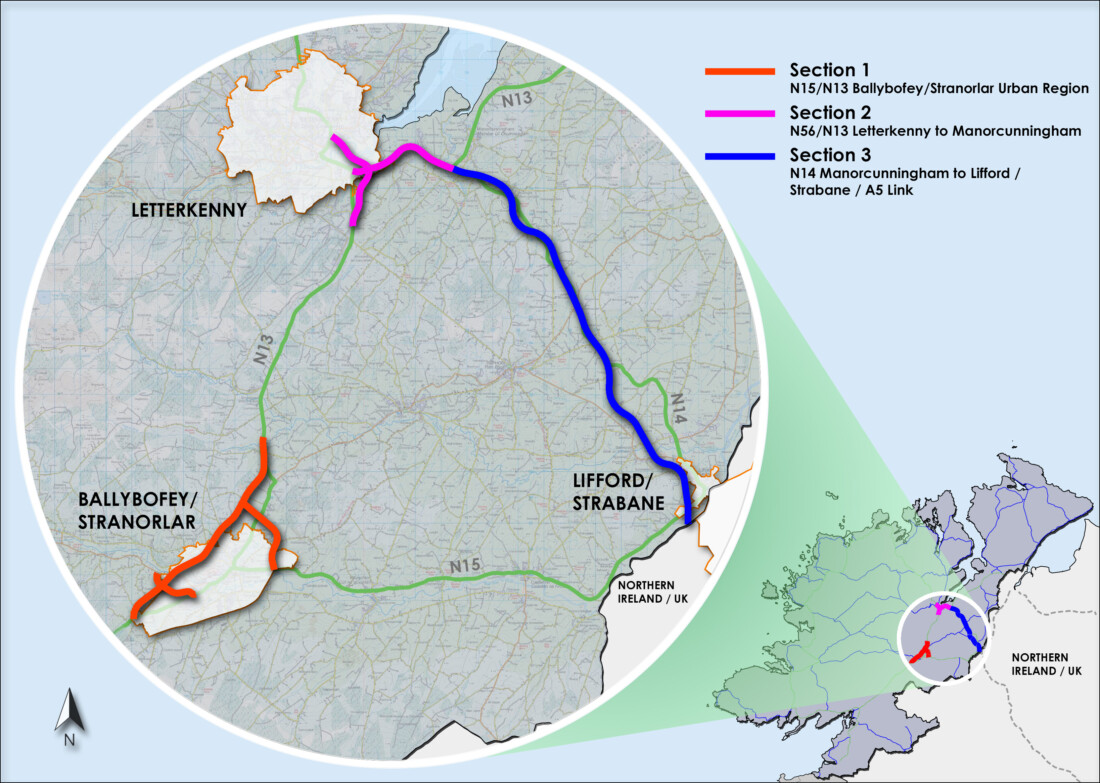


A significant milestone has been reached for Donegal’s major TEN-T roads project, with key planning, environmental and Compulsory Purchase Order documents now published and public submissions invited as part of the statutory approval process.
For years, the TEN-T project has existed as a proposal that’s been discussed and debated.
With the publication of formal planning and CPO documentation, it now moves to An Coimisiún Pleanála, with an eight-week public consultation period to follow. In this phase, its detail, impact and viability will be tested in full.
There’s no doubt about the scale of what is being proposed. The project would improve approximately 42km of national primary roadway, including the Ballybofey/ Stranorlar bypass and the realignment of the N13 from Listillion.
It would also include a new River Swilly crossing in Letterkenny, aimed at easing traffic congestion in the town, as well as upgrading the existing dual carriageway and new road from Manorcunningham to Lifford, providing a direct connection to the A5.
The project has been described as the largest investment in transport infrastructure in Donegal’s modern history, and that is not an exaggeration. It’s an ambitious attempt to address long-standing issues around connectivity, journey times and road safety, while strengthening links to Derry and the wider north-west region.
For supporters, the potential benefits are clear. Improved infrastructure has long been seen as key to attracting investment, supporting business and making the county more accessible for those living, working and travelling in and out of Donegal. In that sense, the case for action is widely accepted.
But as the project moves into the formal planning stage, it also enters a more uncertain phase, as all large-scale infrastructure proposals do.
The statutory process is designed to test not just the need for a project, but how it is delivered, from environmental impact and route selection to land acquisition and community effect.
Submissions will be made, concerns will be raised, and undoubtedly objections will follow. It is a required process, but rarely straightforward. Meanwhile, public confidence in the State’s ability to deliver major infrastructure has been tested in recent years.
The experience of the National Children’s Hospital, where timelines extended and costs escalated well beyond original expectations, has shaped how many people view large-scale infrastructure projects.
It’s not that the need for investment is questioned, but that confidence in delivery is no longer
assumed.
That is not to say the State has never delivered major infrastructure successfully. The motorway network, the Dublin Port Tunnel, the M50 upgrades and other major road projects show that large schemes can be completed and bring lasting benefits.
But in the public mind, recent high-profile overruns carry weight, and the question now is not only whether the TEN-T project is justified, but whether it can be delivered within anything close to the timeline and budget being discussed at present.
Closer to home, the A5 Western Transport Corridor offers a more direct comparison. Like TEN-T, it is a project with a clear strategic rationale and strong political backing. Yet it has also faced delays, legal challenges and rising costs over a prolonged period.
It illustrates how infrastructure schemes can evolve once they move beyond proposal and into the realities of planning, environmental scrutiny and legal process.
The timeline currently points to an earliest start date of 2028, with completion potentially in the early 2030s. Those projections are evidence of the scale of the project and the processes still to come, from planning decisions and possible judicial review to procurement and construction.
It would be a significant achievement to see a project of this size delivered within that timeframe. But experience suggests that such timelines are optimistic.
That’s not a criticism of the project itself, nor of the need it aims to address. It’s simply the reality of large infrastructure delivery, where multiple parts move together.
For now, the focus will be on the statutory process. Over the coming weeks, the detail of the project will come into sharper view, particularly for those it directly affects.
Their voices, alongside those of statutory bodies and the wider public, will form part of the next stage in determining its future.
The TEN-T project undoubtedly represents a significant opportunity for Donegal and it’s important that the people engage with the process.
Realistically, though, there is no real guarantee around when it might actually come to pass.