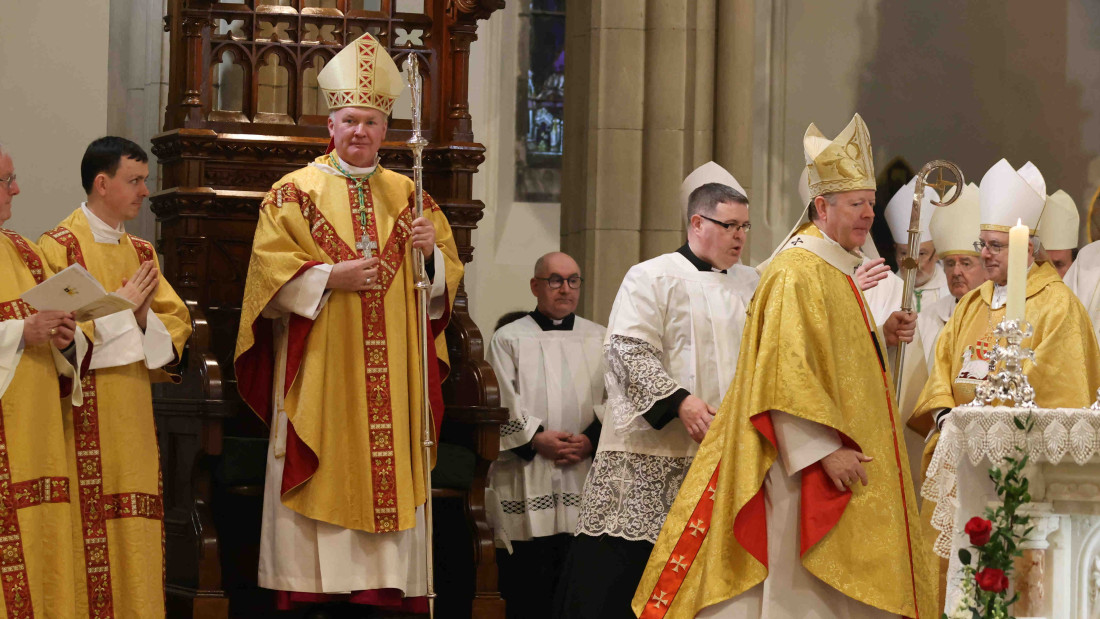


On Sunday in St Eunan’s Cathedral, Niall Coll was installed as the new Bishop of Raphoe.
In his homily, he spoke of a Church living through a secular age, about decline and damaged trust. But he also suggested something much less talked about in public discourse: that faith hasn’t disappeared and in fact there’s renewed interest, even if the way people practice has changed.
The 2022 Census showed that 69 per cent of people identified as Roman Catholic in Ireland, down from 79 per cent in 2016, while 14 per cent recorded having no religion. Statistics like these matter because they identify trends, and trends influence decision-making. But numbers don’t capture the nuances of human experience. They can’t tell us what people reach for, not only in loss, but in the ordinary run of life; in moments of gratitude, celebration and searching. At a wake or a funeral, nobody arrives with an opinion poll. People gather with a weight on their chest and a hollow feeling they can’t quite name. And again and again, you see families leaning. They lean on the priest who calls to the house, listens to stories, and helps shape a life into a few minutes of words that can be spoken aloud. They lean on the community that turns up: neighbours, friends, and old classmates and others who just want to show support. They lean on ritual, too: familiar readings and familiar responses, because when grief makes everything strange, familiarity is comforting.
A lot of that goes unseen in an increasingly secular society because it’s not easily photographed. You can take a picture of an empty pew; you can’t capture the late-night phone call or the steadying hand on a shoulder. And it isn’t only funerals. Much of what sustains parish life is quieter than that. It’s the visiting and checking-in, the sacristy work nobody sees, practical kindness, and small rituals that mark weeks and seasons.
For many, church is still a place to steady themselves, to make sense of things, or to serve, not because life is at its worst, but because they don’t want to live it on the surface. We often talk about religion now as either devotion or irrelevance: you’re either fully in or you’ve left it behind. But real life is rarely that neat. For many, faith and church are not something they “do” in a constant, weekly way. They’re something they come back to, at different stages or thresholds.
None of this cancels out the hard truths. The Church in Ireland cannot simply ask to be trusted; trust is something earned. The wounds of the past are real and they have changed the landscape permanently. But it’s possible to hold two thoughts at once: the institution has been deeply damaged, and yet the local parish – the priests, the choir, the volunteers, the people who tidy the church – can still be a place where people receive guidance, support and connection. Secularisation doesn’t automatically have to mean that religion disappears. Researchers linked to Notre Dame University in the US have argued that secularisation can be better understood as a declining scope of religious authority. Indeed, that feels broadly consistent with what Bishop Coll was acknowledging. The automatic deference is weaker than it once was. But that doesn’t mean faith, or the desire for meaning and belonging, has vanished. All of this matters because Bishop Coll begins his ministry at a moment when the Church’s place in public life, particularly in education, is being actively reconsidered.
The Department of Education is asking parents and school communities what kind of primary school provision they want, including whether schools should remain denominational or move towards multi-denominational models.
The direction is clear: authority is no longer assumed; the question is what families choose.
And while census figures can tell us what people tick on a form, Bishop Coll has spoken to something more searching. He is not measuring the future by whether the Church regains past levels of practice, but by whether people will choose, freely and consciously, to engage with faith in the circumstances they actually face.
In that, there is realism, but also an invitation: not for automatic participation, but conscious engagement.