


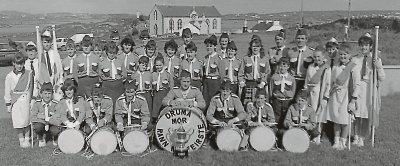


ON a bright summer day, June 6, 1976, the streets of Ranafast echoed with the first proud notes of a new band. Originally called Buíon Cheoil Rann na Feirste, this group of musicians would later become known as Druma Mór Rann na Feirste, taking inspiration from the book of famous writer Seosamh Mac Grianna.
But this moment did not appear out of nowhere. It was born of a long tradition, of generations of local musicians and of families who had marched in bands for over half a century in the Rosses. In the early 1900s, bands from Ranafast could be seen performing on St. Patrick’s Day and Easter Sunday outside St. Mary’s Star of the Sea Church in Annagry. Yet times were turbulent—civil war, emigration, and political divisions existed. By 1936, after a performance at Mass in Mín Uí Bhaoill, the original band ceased to exist. The original bass drum of that band, An Druma Mór, lay in the attic of Teach Jimí Hughdie for over 50 years. This original drum would later be played once again in Annagry on Easter Sunday in 1992 by Patsy Anne O Domhnaill and in 2016 to mark the 1916 Rising by Donall Mac Ruairí and is now proudly displayed in Aislann Rann na Feirste
A SPARK REKINDLED
Decades later, as young people returned from Scotland and London, the spirit of music and community began to stir once more. On St Patrick’s Day, in a small public house in Mín a’ Leice, Micí Mhary Mhicí Ó Gallachóir and Hughie Doherty dreamed aloud of forming a new band for Ranafast. Young men from the townland had been marching with Band Ghandi until it’s demise. Their timing was perfect: that year, Coláiste Bhríde celebrated its golden jubilee, welcoming dignitaries including President Cearbhall Ó Dálaigh and Archbishop McConmidhe. A band to greet them would be more than ceremonial—it would be a symbol of pride, resilience, and tradition.
And so, Buíon Cheoil Rann na Feirste was born. The all-male band wore their own suits, adorned with a simple sash, and adopted the fife as their instrument. Children from the local school band were invited to join, blending youth and experience. From the very start, the band performed at Mass on St. Patrick’s Day and Easter Sunday, weaving music into the rhythm of community life.
RISING TO THE CHALLENGE
By 1980, inspired by the competitive success of the Keadue Band, An Druma Mór took its first tentative steps into competitions. Early outings were difficult—the judges were unimpressed, and the band struggled to make an impact. Led by Neddy Mhary Hughie O Gallachóíir their repertoire included traditional marches such as The Boys of the Old Brigade, The Foggy Dew, and Henry Joy, pieces that still echo through the townland today.
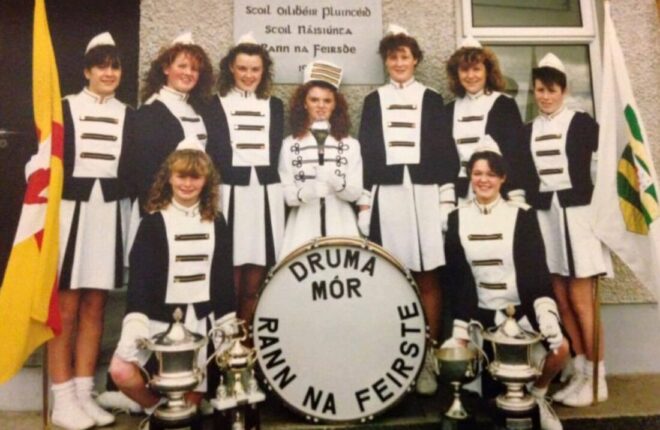
The band in 1990.
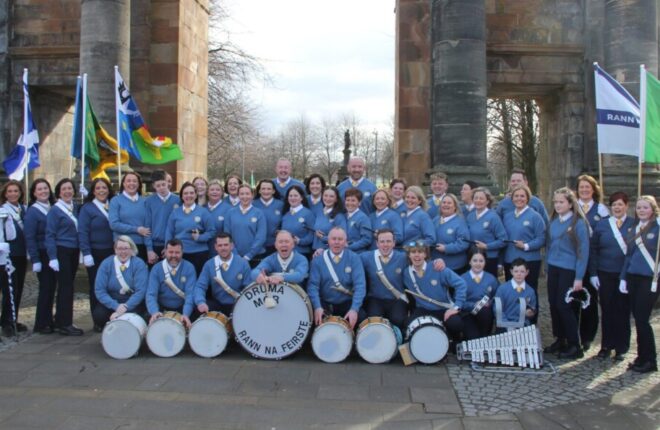
The band pictured earlier this year in Glasgow.
New uniforms followed: green trousers or skirts, crisp white shirts, green bow ties, and bright orange jackets. But the true turning point came in 1983, at a competition in Falcarragh. A visiting adjudicator, Fergus Cobain, saw beyond the challenges. A master flautist from Belfast, he recognised the band’s potential and soon became their Musical Director.
Under his guidance, the band transformed. Intensive rehearsals, careful tuning, and dedication to musicality elevated the group. Traditional marches were joined by new tunes — La Rêve Passé, Gordon’s Castle, Jamaican Folk Suite, and Pepita and were ledby Charlie Ghracie Mac Grianna. Popular pieces such as Rivers of Babylon, Super Trouper and Chitty Chitty Bang Bang delighted crowds, showing that the band could honour tradition while embracing modern tunes.
A LEGACY OF EXCELLENCE
In 1986, An Druma Mór travelled to Listowel for Fleadh Cheoil na hÉireann to face the Clooney Flute Band, finishing second. This small victory ignited ambition, and the following year, the band returned stronger. With new navy blue and white uniforms and the precision guidance of former army sergeant Doc O’Connor assisted by Seamus Gallagher from MullaghduffDublin An Druma Mór became a force to be reckoned with.
On August 23, 1987, the band was crowned All-Ireland Champions – a triumph that marked the beginning of a golden era. Further victories followed in 1990 and 1991 which was led by Caroline Greene. In 1989 at the Champion of Champions in Derry, where An Druma Mór achieved a perfect score of 100, winning Best Music, Best Drum Corps, Best Conductor, and Best Band. A win like this has never been repeated by any band.
For a band from West Donegal, these accomplishments were astonishing—but even more remarkable is that, from the early 1980s through the late 1990s, An Druma Mór thrived in a wide range of competitions across multiple generations, proving they were never confined to a single genre or set of musicians
THE CONCERT FLUTE REVOLUTION
On January 1, 1993, An Druma Mór made a bold and daring choice: to replace traditional fifes with silver concert flutes. This required retraining, patience, and discipline. Within six months, the band won Donegal and Ulster Fleadh Cheoil competitions.
As piccolos, treble, and bass flutes were added, the sound deepened, becoming richer, more complex and more expressive. In 1996, the band made its Belfast debut with The Diamond Star, earning second place, followed by All-Ireland victories with Eine Kleine Nachtmusik by Wolfgang Amadeus Mozart, Brahms’ Hungarian Dances No. 5 and 6, and St. Anthony’s Chorale. The band also performed Orpheus of Underworld by Offenbach, Pirates of Penzance by Gilbert and O Sullivan and Lucia Silva by the aforementioned Mozart.
The precision, musicality, and dedication required for these accomplishments were staggering, but An Druma Mór rose to the challenge, proving that a small townland in West Donegal could compete in the home of concert flute playing and be successful.
CHALLENGES, HIATUS AND REVIVAL
Despite continued success, the late 1990s brought challenges: emigration, work, and college commitments reduced membership. In 1999, after a final Easter Sunday victory, the band took a step back, pausing competition to focus on nurturing the next generation.
Eight years later, on March 17, 2008, Druma Mór marched proudly again, reigniting a flame of music, friendship, and community.
TODAY AND BEYOND
Today, nearly 50 members carry the band’s proud legacy forward. They march annually from Ranafast to Annagry, travel to Gaoth Dobhair on St Patrick’s Day, and perform in Dungloe on Easter Sunday, joining local events and celebrations.
In 2026, for the band’s 50th anniversary, Druma Mór travelled to Glasgow for the St Patrick’s Day Parade. The theme of emigration resonated deeply, reflecting the historical connection between Donegal and Glasgow, and the enduring spirit of the community. This trip would not have been possible with the generous contributions from local businesses and the locals. A further example that the band belongs to the community,
There will also be a special hour-long programme on RTÉ Raidio na Gaeltachta which will be broadcast later in the year.
EASTER SUNDAY 2026: HONOURING THE HEART OF DRUMA MÓR
This Easter Sunday, An Druma Mór will come together like never before—a celebration of memory, tradition, and community. From Ranafast, the band led by Deirdre Rua Mc Fadden will march along the White Cross Road to Annagry for 11am Mass, honouring the members who have gone before us. Each step will echo with gratitude, remembrance, and the enduring spirit of those who shaped this band.
They will also march in solidarity remembering past members who now live far from home, and they will celebrate the dedication of their present members—the heart and soul keeping An Druma Mór alive for future generations.
After Mass, the journey continues to Dungloe, where the Superband event will bring together 11 fife bands in a breathtaking display of unity, pride, and tradition—a moment that will stir hearts and lift spirits. Performances in Sharkey’s Bar and finally in Leo’s Tavern will complete a memorable day of celebration for the band. This Easter, join An Druma Mór to remember, celebrate, and be part of a living legacy that honours the past while marching into the future.
A TRIBUTE
The success and longevity of the band would not have been possible without the dedication of many individuals.
The band remembers with great respect those who are no longer with us—Tony Doherty, Jimí Mhicí Jimí Mac Grianna, Fergus Cobain, Seamús Gallagher, and Doc O’Connor—each of whom played a vital role in shaping its legacy.
Gratitude is also extended to Denis and Susan McGarvey for their tireless work in maintaining uniforms, instruments, and preserving the band’s history with their many photographs and videos.
Special recognition is given to Hughie Doherty and Donal Rua O’Donnell, whose commitment over 50 years has been central to the band’s success. For 50 years, they have been the heart and soul—guiding, teaching, inspiring, and above all, keeping it alive.Their legacy lives on not only in the music, but in the friendships, pride, and spirit that define An Druma Mór.Their passion, commitment, and diligence ensured that the music would continue, that the band would thrive, and that generations of musicians could experience the joy of performing together.
A LIVING TRADITION
For 50 years, this band has carried the music, the spirit, and the pride of Rann na Feirste . And for generations to come, it will continue to do so. At its heart, Druma Mór Rann na Feirste is about more than competition or performance. It is about people. It is about community. And it is about a tradition that continues to bring generations together. As the band celebrates this milestone anniversary, it does so with pride and optimism for the future. Here’s to the next 50 years.