


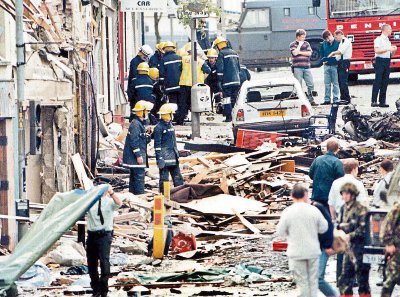


THE Real IRA bombing of Omagh in 1998 was carried out with the ‘operational co-operation’ of both the Continuity IRA and the Irish National Liberation Army (INLA), an expert in military republicanism has told the Omagh Bombing Inquiry.
Dr John Morrison was giving evidence on the second day of hearings as part of Chapter Three of the inquiry which is taking place in Belfast.
He said it was deemed likely that the two dissident republican organisations, or members within them, were involved in the explosion.
He added that the Omagh Bomb was a ‘clear example’ of terrorist activity, and went on to assess the history of the development of the IRA, spilts within the organisation and the development of splinter groups over the 30 years or so from the 1960s until the late 1990s.
On August 15, 31 people including a woman pregnant with twins, were killed in the explosion on Market Street in the town.
Among those killed were three young boys from Buncrana and two members of a Spanish exchange group which had been staying in the Donegal town. The group had travelled from Buncrana to Omagh on the day of the bombing.
Dr Morrison pointed out that the aim of the Real IRA at that time was to destabilise the the peace process and disrupt normality.
He said that the organisation was doing thris in order to seize back control from the IRA and was pursuing a strategically time bombing campaign.
He said that at the time the Real IRA had been considering targeting military installations in the North which may include the deaths of soldiers or other military personnel, or carrying out a tactic of car bombs in towns.
Some members expressed concern about the risk of innocent civilians being killed in car bombs.
However, this tactic was adopted because of the fact that car bombs were ‘cheap, easy to manufacture and transport’ and that it was ‘tragically so’ that those who advocated their use came out on top within the organisation.
‘Violently active’
The inquiry was told that about a third of those involved in the organisation were ‘violently active’ and that it had around 90 members in total.
He added that they had ‘significant experience, access to weaponry and had a capability to carry out a mounting campaign of terrorism’
Dr Morrison said that utlimately the view that the bombing of town centres should be the priority at that time, but cautioned that it was difficult to be fully accurate despite the fact that the Real IRA was a ‘relatively new’ organisation at the time.
The inquiry was told that the Real IRA drew its members from the border counties, including Louth, and that it was also active in Dublin and Cork.