


Wild Conamara – RTÉ1, Sunday, 6.30pm
Dear England – BBC1, Sunday, 9pm
Shergar: The Racehorse And The IRA – Channel 4, Saturday, 8.30pm
Miles Davis: Birth Of The Cool – BBC4, Friday, 9pm
Connemara” is the usual spelling for that part of Ireland, but RTÉ have opted for the Irish spelling in their new Sunday night natural history series Wild Conamara…which is fine, of course, though in much of their radio and podcast publicity about the show, they still spell it “Connemara”. Helpful as ever, our national broadcaster.
Still, I suppose the Sunday teatime slot has become shorthand for a certain kind of documentary series: you know, that conspicuously poetic, slightly slow-motion look at Ireland that asks us to take a moment and, ah, genuflect just a little at how wild and untamed and beautiful our Irish shores and hearts are.
And in case we’re still unsure about how to feel, never worry, RTÉ will slather it with soundtrack too.
But let’s not be too hasty: maybe it just caught me on a bad day. Because, in fairness to Wild Conamara, it is still a beautiful thing to watch; presenter Eoin Warner has a quiet and unobtrusive presence, and the whole thing appears to have been filmed on a weekend last year when Ireland was whisked off (while the human population slept) to Hollywood for sunlight and colouring.
The first episode included some wonderful drone shots of the coastline, some curious seals and great skuas, and a fascinating gathering of basking sharks that, according to the local fisherman talking about it, was the best in 50 years.
It’s also a calming film, at least when you’re not sighing pointedly at its ever-so-slightly syrupy approach. Because that just makes it feel, at times, a little bit less than real – and our coasts and critters are beautiful enough not to need it.
Luckily there is plenty of life here too, and Warner also gives us good information about his subjects’ lives and their populations’ recovery – so it’s still more good than bad. But maybe give us some grit next time, please.
Dear England
Based on James Graham’s Olivier Award-winning play, Dear England is a four-part Sunday night BBC drama charting Gareth Southgate’s stint as the manager of the England football team — a period before which he was most famous for missing a penalty at Euro ’96.
Joseph Fiennes played Southgate on the stage, and he does so again for the TV show, while various other players whose names are familiar even to me drift in and around him, albeit with faces that are a bit less recognisable than Fiennes’.
It’s solid, well-meaning drama, though it will appeal mainly to football fans.
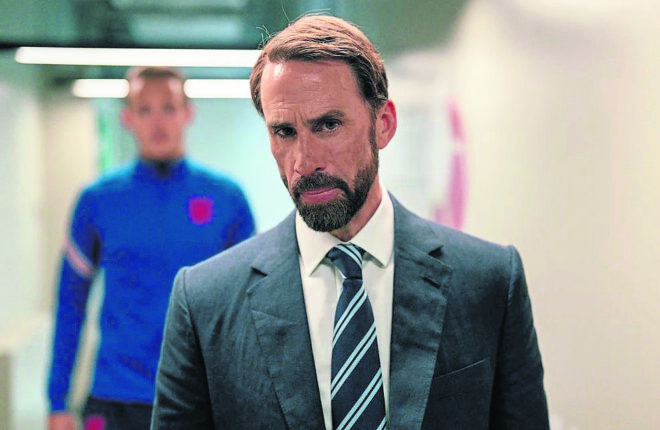
Joseph Fiennes plays the role of Gareth Southgate in the four-part BBC drama Dear England.
Of course the makers are aware of that, and try to make it about more than just football: prime ministers come and go, Covid looms, the Queen dies…and all the while Southgate quietly unites the team/country, having many an earnest exchange with the players and even bringing in a sports psychologist to help them (that’s Pippa, played by Jodie Whittaker), which also gives the show a welcome opportunity to include some female warmth amid all the sweaty geezers.
It’s a little bit preachy, then, and it doesn’t always avoid caricature. Fiennes does good work as Southgate, but, always quite a mannered actor, he sometimes feels like a very studied bag of tics; but he does capture the look better than some of the other figures here.
The show itself is a bit nice-but-boring, but I do have to offer a disclaimer. It’s a drama about English football that wants to show it as transformational and inspiring; as an Irish man who finds football completely meh, and is far too cynical for the inspirational tones here, I am clearly not the target audience.
Shergar: The Racehorse And The IRA
Speaking of sports events that can unify a nation, the documentary Shergar: The Racehorse And The IRA certainly explores one: not only was it a serious talking point in Ireland in 1983, but it’s provided the punchline for many a tired joke (usually also involving Lord Lucan and Elvis) in the decades since.
So, if you’re young enough that you don’t remember much about it, no doubt you should be tuning in.
More than forty years on, though, Shergar’s disappearance remains an unsolved mystery, and this documentary makes a…well, a slow but sure-footed case that the story is still worth retelling.
It charts (quite efficiently) the horse’s rise from Derby winner to one of the world’s most valuable stallions under the Aga Khan, before, abruptly, armed men abducted him from his Kildare stud in February 1983 (and demanded a £2 million ransom).
The kidnapping itself — head groom James Fitzgerald held at gunpoint, the horse loaded into a waiting horsebox and gone within minutes — is reconstructed here with surprising menace, though the rest of the story is somewhat murkier. That’s inevitable, since all it can do is hint at what became of the horse or the investigation, or even what kinds of debates went on in the syndicate about meeting the kidnappers’ demands.
The most compelling ingredients come from racing commentator Derek Thompson, who was directly involved in attempts to secure the horse’s release (and received ominous calls from a man using the codename “Arkle”).
It’s soft going at times, and the lack of new information is disappointing. But as with Dear England, it’s about more than just sport. It might even be more interesting as a snapshot of Ireland at that time: deep in the Troubles, a place where even a missing racehorse could feel like an act of aggression (though, frankly, it’s hard to take too seriously the moments when Ivan Yates is on it, seemingly emotional about the lost legacy and profits).
It’s perhaps a bit odd, in a story of a kidnapped horse, to see the national political context being explained, but it makes sense here.
Miles Davis: Birth Of The Cool
Meanwhile, BBC4 screened Stanley Nelson’s documentary Miles Davis: Birth Of The Cool on Friday night: a somewhat dry but solid introduction to the life and long career of Miles Davis, one of jazz’s most transformative (and sometimes difficult) figures.
There are real revelations here, like the sheer spontaneity behind Kind Of Blue and other works (some of his most famous pieces were recorded with almost no rehearsal), his constant absorption of new music, and the personal and musical restlessness that saw him reinvent jazz and himself several times across half a century.
The cast of people he worked with (some of whom speak here, even daring to mimic his famously raspy voice) is incredible on its own: John Coltrane, Herbie Hancock, and Wayne Shorter, for example.
The film doesn’t shy away from Davis’ darker side either – and there was plenty of it, borne of the America he grew up in, and of an innately suspicious nature. His ex-wife Frances Taylor Davis speaks candidly (though still affectionately) about the abuse and control she endured, and his heroin addiction is handled briefly but honestly.
The talking-head structure perhaps gets in the way a little, and long-time fans might prefer a longer film (there’s certainly enough material), but for curious non-experts (like me) it’s certainly a sound place to start (and not a bad way to finish a working week).
The Channel Hopper column, written by Paul Bradley, features every Thursday in the Donegal News.