





I admit I’m a bit mystified by the recent trend in TV shows to present us with nothing more than snotty rich people being snotty; or perhaps I should say I don’t really understand why such things have become popular.
Think of the success of the glossy The White Lotus, or almost anything else Nicole Kidman has been involved with in the last decade; to me, that show was deadening enough on its own without also infecting other shows which would be distinctive enough without it.
Beef is one of those other shows. In 2023 season one became a masterclass in sustained tension, with a genuine grudge fight between Steven Yeun and Ali Wong. But the new second season has more White Lotus blood in its veins than is healthy.
Here, Carey Mulligan and Oscar Isaac play Lindsay and Josh, a married couple running a luxury country club: she’s a status-obsessed English posh girl going slightly (in her own eyes at least) to seed, he’s the gambling general manager fighting his own bad decisions when he’s not fighting with Lindsay.
They are caught in the middle of a huge, image-spoiling row by lowly employees Austin and Ashley (Charles Melton and Cailee Spaeny), after which, via a mixture of blackmail and desperation, all their lives begin to change.
At this point, the show begins to multiply both its cast and its subplots, taking in everything from cultural differences, racism, healthcare, debt and corruption, to the vacuousness of the wealthy lives the characters are chasing; but without meaningfully exploring any of them.
Everyone is obnoxious. Now, you might think Austin, who is initially shown as so stupidly harmless that he tries to save dying insects, is all right – but come on, he leaves the beepityboopity keyclick sounds on his phone, so how decent or considerate can he really be?
It doesn’t help that Melton’s performance as Austin is mumbled against an unusually busy (and annoying) soundtrack; you might have to switch on subtitles. And, unlike season one, it’s never clear what the actual “beef” of the title even is, or between whom we’re supposed to feel it: everyone, basically, is agin everyone else, and none of them earns our sympathies.
What saves it from being a complete waste is a stylish look and some fantastic acting, and some scenes of toe-curling awkwardness. So, if you can settle with watching it at arm’s length, it may still be sufficiently entertaining; but really, given what went before and the cast involved, that’s not enough.
Come To Your Census – RTÉ1, Sunday, 6.30pm
We’ve probably all had a small peek at the results of the 1926 census recently released online: it’s a particularly interesting one, not only because it was taken just after the foundation of the Irish Free State, in the aftermath of serious upheaval, but also because it’s from the very era to which many Irish families can easily trace their origins (things quickly become very hazy before that).
To mark the release, the National Archives have helped RTÉ produce a six-part podcast about it, as well as a two-part documentary series, Come To Your Census, which launched on Sunday.
It could hardly fail to have some interest for most people: both a big picture of a society trying to get its feet under it, but also a fairly detailed snapshot of three million individuals, their names and occupations, their languages and faith, and, most frequently, their hard lives.
The stories are told here mainly through a handful of familiar RTÉ faces, guided by archivists, retracing their own family histories: architect Dermot Bannon, for example, somewhat perplexed by the different lives people led (he finds one family of 12 living in four rooms, but another of four, living in 12 rooms), and wry trade unionist Mick Lynch discovering his own father, Jack Lynch, who grew up in the same part of Cork as another Jack Lynch, who later became Taoiseach.
There’s more than a touch of Who Do You Think You Are in here, but that’s not a bad thing to emulate: real lives that we all recognise but which were often grimmer than we could tolerate these days.
It’s sometimes touching too, as when broadcaster Gormfhlaith Ní Thuairisg surprises herself with her own emotion: “you don’t think of these people as young,” she says, as good a reason as any to watch this useful and humane show, a reminder of our own fading memories, our dwindling days.
Dermot Bannon’s Celebrity Super Spaces – RTÉ1, Sunday, 9.30pm
Dermot Bannon, almost inevitably, is also on after the Sunday night news, with, yes, a new property show.
This is not one of his turn-this-into-a-big-glass-house shows, this is one of his have-a-gawk-at-how-others-live shows in which he simply looks around a house he’s doing nothing with.
And if that’s not interesting enough for us, never fear: Dermot Bannon’s Celebrity Super Spaces features the homes of Irish celebs, for who could ever get enough of such a subject?
I shouldn’t be too hard, I suppose: it’s hardly exciting but everyone’s being pleasant enough and it’s really just a bit of amicable chat about this room or that ornament.
Sunday’s episode featured homes like comedian Joanne McNally’s in Clapham, the boldly-coloured Dublin one of drag queen Panti Bliss, and the more stately, restored 1940s home of Camille O’Sullivan and Aidan Gillen.
The only vaguely surprising thing was to see chef Clodagh McKenna living in a 300-year-old cottage in the grounds of Highclere Castle in Hampshire, home of the Carnarvon family (you’ll remember the name from the Tutankhamen discovery).
It’s not revelatory or full of useful home décor tips, but I suppose the cheerful blather might help to relax you out of the weekend. That is, if you can tolerate the incessant soundtrack. I just couldn’t. Seriously, though, can RTÉ not give us 2 seconds without swellingbeepingdrumming music, even if only when people are speaking? It’s like watching the TV with the radio on in the room.
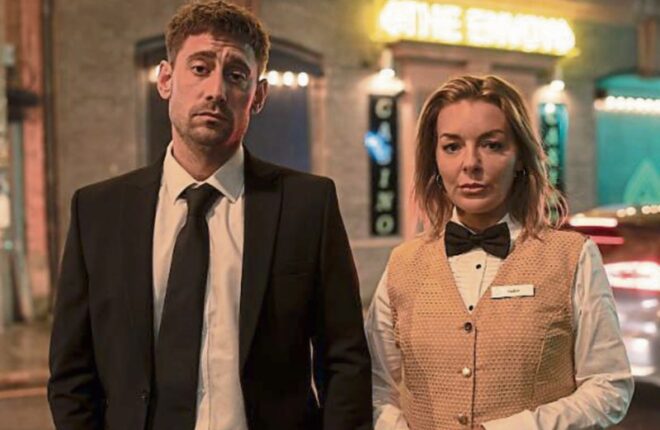
Matty (Michael Socha) and Leanne (Sheridan Smith), stars of The Cage.
The Cage – BBC1, Sunday, 9pm
Less cheery, though not without its humour, is BBC’s new five-part crime drama The Cage, which is set in a Liverpool casino that doubles as a money-laundering front for a drug empire.
The show mainly follows Leanne (Sheridan Smith) and Matty (Michael Socha), two cash-strapped employees independently skimming money from the till, until they catch each other in the act.
It’s written by Tony Schumacher, the former police officer behind The Responder, and it has a similar Liverpudlian, slightly dour, authenticity.
It’s not as good as The Responder, but it has a warmer, sometimes more humorous, tone that keeps you engaged during the less believable moments, and through some heavily-accented, “come again?” dialogue.
Smith is excellent as a single mother pushed to her limits, but it’s Socha who really shines as a very human anti-hero bumbling through a world of harder gangsters.
These two alone make it worth a watch.