


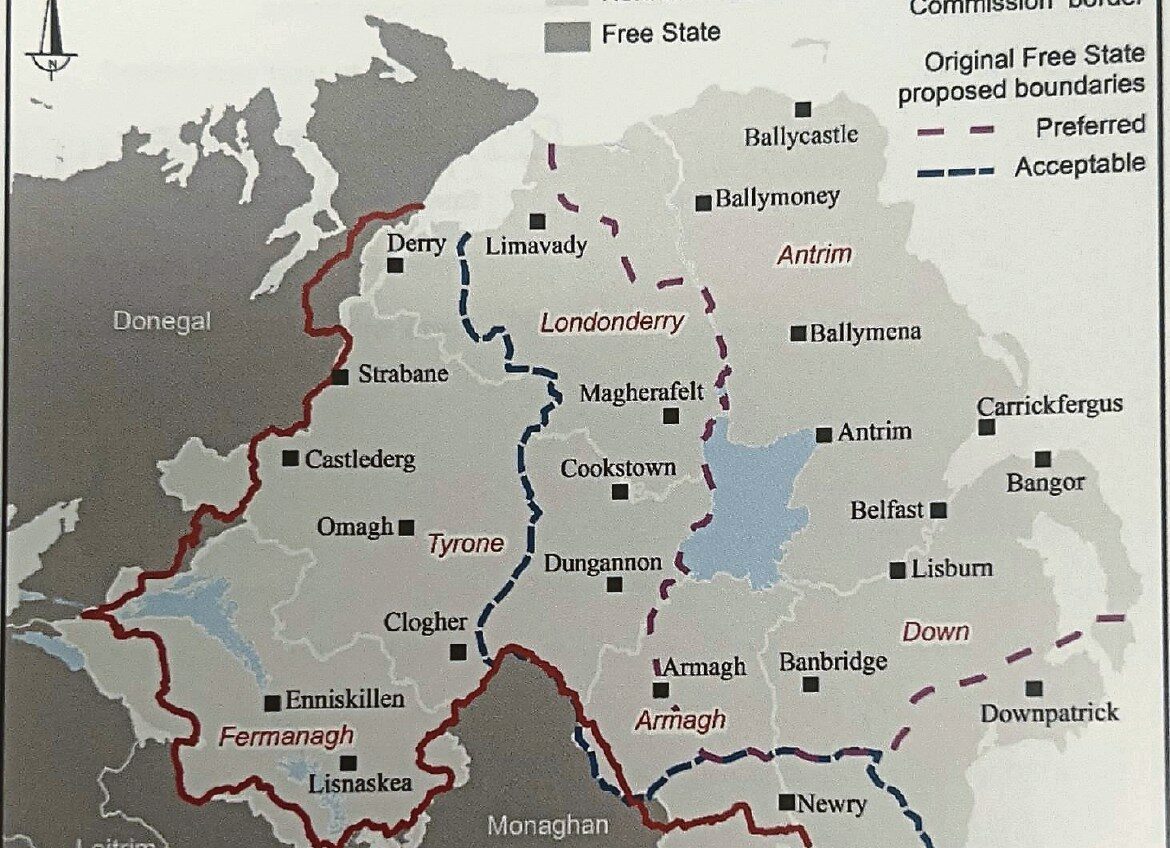


AT a time of great civil unrest in 1923 it was expected in many quarters that the Boundary Commission would admit more nationalist areas in the North into the Republic. The North East Boundary Bureau had been looking at recommendations that year.
In the Donegal border area the proposed list included substantial parts of Tyrone, Fermanagh and west Derry.
One plan mapped Derry city into the south and would have made Derry the nearest city to Donegal within the same government administration.
The Irish Boundary Commission concluded its work and instead of enlarging the Republic the line was left untouched. Those stranded on the wrong side of the border were left aghast. It was enacted in February 1926.
Instead the Free State government extricated itself from payment of its portion of Britain’s national debt and war pensions, by agreeing to let the border stand without modification.
For Donegal too, the consequences were profound.
It was cut off from the rest of the South, with only a seven kilometre wide sliver of land from Manger near Belleek to Bundoran, creating a corridor southwards from Donegal within the Republic.
Donegal simultaneously found itself geographically and economically isolated from both Dublin and the North. This profoundly shaped its lack of development for generations.
Last weekend’s Easter Sunday commemorations in Stranorlar brought partition’s lasting legacy back into sharp focus.
The event remembered the anti-treaty Drumboe Martyrs — four men executed in 1923 by Free state forces — and it drew significant crowds.
Donegal TD Pádraig Mac Lochlainn delivered the main oration, using the occasion to press the case for constitutional change.
“This is the decade in which the question of Irish unity can be resolved,” he told those gathered.
Since 1998 the Good Friday Agreement has brought greater north-south cooperation, and for many, stability remains the overriding priority.
But what last Sunday revisited is that the decision to leave the border unchanged in 1926 did more than settle a political question.
It defined Donegal’s trajectory — and the debate it sparked shows no sign of fading.