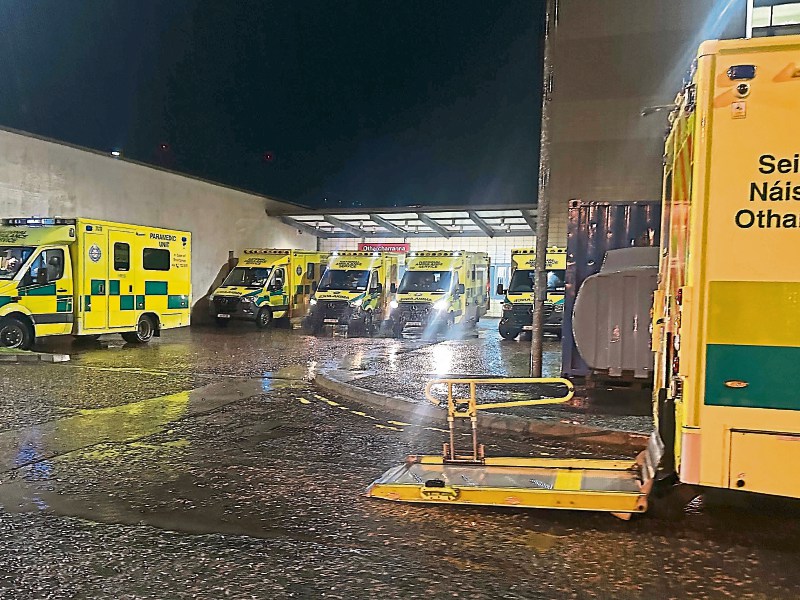


TWELVE ambulances were left waiting hours to offload patients at the Emergency Department of Letterkenny University Hospital, the latest meeting of Regional Health Forum West heard.
The incident has led to renewed calls for greater investment in the ambulance service as demand continues to grow across Donegal.
Councillor Gerry McMonagle told the meeting on Tuesday of last week that 12 ambulances were left waiting hours last month to offload patients.
The ambulance backlog was caused by a surge in Emergency Department presentations, which ultimately affected response times.
He described the incident as a cause for concern and called for “massive” investment in the National Ambulance Service.
Currently, the National Ambulance Service maintains eight stations across the county.
However, the service operates on a countrywide basis and mobilises responses to calls based on clinical priority, in accordance with their model of dynamic deployment.
In this respect, ambulances may travel to and be dispatched from various locations, irrespective of their base, since they are not confined to work in specific geographical areas.
Each year, the service tracks and reports monthly on ‘purple’ and ‘red’ call activity, for example, those calls categorised as AS1 (life threatening cardiac or respiratory arrest or life threatening other than cardiac or respiratory arrest).
In 2026, the KPI target for each category is 75 per cent of clinical status PURPLE incidents responded to by a patient carrying vehicle in 18 minutes and 59 seconds or less, and 45 per cent of clinical status RED incidents responded to in 18 minutes and 59 seconds.
In January, neither category met the annual response time target.
Of the 105 purple calls recorded, 61 per cent were responded to within the set timeframe, while just 37 per cent of the 2,823 red calls received a response on target.
“We are not meeting the response times,” Cllr McMonagle said.
“Massive investment is needed in the National Ambulance Service.
“There is still worry when people lift the phone and they’re waiting for an ambulance.
“Eight times out of 10, it is not their local ambulance that arrives at their door, it is more likely someone from another part of the county, and sometimes outside the county.
“If you lose two ambulances from Inishowen due to being stacked up at LUH, it is a long drive from anywhere else in Donegal down into Inishowen to respond to calls.
“We need more investment in the ambulance service in Donegal to meet the demand.”
Agreeing with Cllr McMonagle, Brendan McGovern, general manager of the National Ambulance Service West and North West, acknowledged that some of their response times are below the desired standard.
However, he said they work closely with hospital staff to hand over patients to the Emergency Department as quickly and safely as possible, allowing ambulance resources to be freed up for responding to calls in the community.
“From a National Ambulance Service perspective, where multiple resources are delayed at Emergency Departments, our management teams will escalate the problem to successive levels of senior management at the hospital site and beyond and work with them to develop a situation specific plan to relieve pressure and release resources,” Mr McGovern said.
“This may include joint assessment and screening of lower acuity patients who may be “fit to sit” at ED awaiting treatment by hospital staff, and the “cohorting” of more than one ambulance patient under the clinical care of an existing crew awaiting while handover at the Emergency Department.
“Both of these measures are intended to release ambulances to respond to the next patient in need in the community.”
Mr McGovern said the demand for the service is increasing five per cent year on year.
“The length of time for some of our responses is not where we would like to be and there are a number of reasons for that, including the increase on call volume, changes in people’s health seeking behaviour and the challenges we have in terms of our capacity at hospitals as well,” he said.
“We are doing everything we can to ensure that we free up resources and return them to the community as quick as possible.”