


by Sean Hillen
DAVID and Cat McCann are passionate about sea life – that’s how they ended up on the far side of the world setting up a marine research organisation in Malaysia.
Now living in Derrybeg, having established the social enterprise, The Sea Collective, they participated in National Biodiversity Week as ‘marine detectives’ revealing to participants how the shoreline of Gaoth Dobhair teems with life.
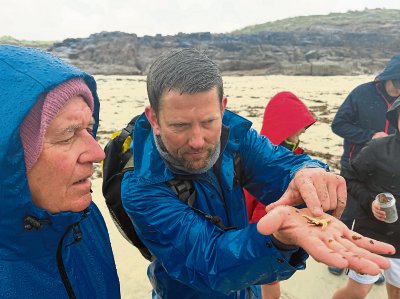
Cat McCann illustrates Ireland’s vast marine territory during the National Biodiversity Week event in Gaoth Dobhair.
“Ireland’s marine territory is almost one million square kilometres, about ten times the size of its landmass, and over five kilometres deep in places,” said Belfast-born David, 41, a marine biologist with a Masters degree in environmental management and conservation.
“And Donegal, having the longest coastline of any county, is particularly important, the only county where all 27 different types of cetaceans – whales, dolphins and porpoises – have been officially documented.
“Six months ago, the 27th, the remains of a narwhal, a long toothed whale, were discovered in Inishowen.”
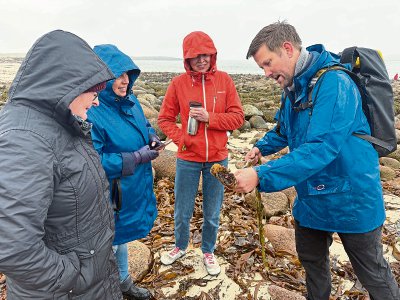
David McCann describes seaweed growing in Donegal.
In addition to crabs and little-known fish known as blennies, participants on the shoreline walk were introduced to different kinds of seaweed, some with esoteric names such as sugar kelp, bunny ear, dead man’s fingers, sea spaghetti, Icelandic truffle and coralline algae that resembles coral.
“There are around 500 different kinds of brown, green and red seaweed around Ireland, some
invasive, often left behind
when container ships pump out their ballast of water,” said David.
“Japanese wire weed is prolific and can blot out sunlight in rock-pools making it impossible for native seaweeds to flourish.”
But most seaweeds are healthy to eat.
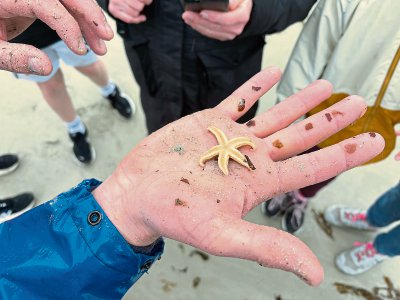
Starfish – they extend their stomachs through their mouths to digest food.
“Many can be added to salads and other dishes,” said Columbia Hillen, a medical herbalist and participant on the walk.
“The Icelandic species really tastes like truffle and many top chefs use it. Another species, pepper dulse, has a strong taste of garlic bread. You can also grind some seaweeds into powder and put them in soups to add minerals to your diet.”
David said Ireland’s marine environment is home to around 2,000 crustaceans including crabs, as well as sea mollusks. “Many people don’t realise crabs have tails, that’s how you tell a male from a female, the female’s being broad and triangular, the male’s long and thin. And limpets have the strongest tongues of any creature.”
He added, “As a strong advocate of citizen science, here people actively participate to increase our knowledge base, I would encourage contributing to the Explore Your Shore survey,” he said.
Donal O’Cnamhsi, Irish language planning officer, also on the walk, said, “Donegal has a strong coastal heritage with so many people making a living once from the sea, so education initiatives such as David and Cat’s are very important to keep that history alive.
“You don’t need to watch David Attenborough to see marine life, it’s right on our doorstep.”
Donegal County Council’s Biodiversity Office is organising events this week with support from the Heritage Council and the National Parks and Wildlife Service.
If you are interested in learning more, information can be found at https:theseacollective.ie and https:exploreyourshore.ie