


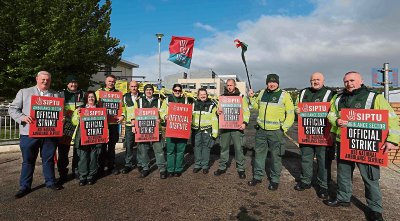


ON Tuesday, staff from the National Ambulance Service (NAS) in Donegal undertook 24 hours of strike action as part of a long-standing dispute with the HSE, which is accused of failing to update salary scales in recognition of the increased responsibilities.
There were pickets at ambulance bases across the county, including Dungloe, Carndonagh, Ballyshannon, Killybegs, Donegal Town and Letterkenny.
SIPTU, the trade union representing 95 per cent of NAS staff in Donegal, has said the HSE has failed to implement the findings of an independent report that recommends updated salary scales to reflect changes in staff responsibilities and workload over the last 20 years.
The 300 members have also undertaken a work-to-rule industrial action, which involves non-co-operation with new procedures or changes.
SIPTU health division organiser Ciaran Sheridan, who is involved with the dispute at a national level, warned that they are preparing to continue next week with a 48-hour stoppage on Tuesday and Wednesday. This will be followed by a 72-hour stoppage beginning on Tuesday, May 26, and then further rolling strikes if there has been no intervention or resolution.
Standing on the picket line in Dungloe was Adrian McGeehan, an Advanced Paramedic. He warned the ambulance service is already under severe pressure and faces a worsening recruitment and retention crisis if pay parity is not achieved.
“Although the strikes are an inconvenience and a temporary disruption to the workforce, if this isn’t resolved this is going to be a permanent disruption to the workforce because the staff just won’t be there.”
Adrian spoke about how the profession has evolved and how educational requirements have increased significantly over the years, yet this has not been recognised in line with other health care professionals.
Adrian also highlighted how the role itself has transformed significantly.
“Twenty years ago we were primarily a patient transport system, but now we are bringing the emergency department out into the community.”
With the service already stretched, Adrian explained how staff are making major personal sacrifices to keep it running.
Adrian described how a call coming in minutes before the end of a shift can mean finishing hours late, missing saying goodnight to his three children, or sometimes not seeing them for days because he is leaving for work before they wake up again.
He also spoke about the psychological toll of the role, which can involve attending traumatic incidents before quickly returning to duty. “Often within an hour we are dusting ourselves down and back on the road.”
Working from a rural base also adds to the challenges they face. He said crews can spend anywhere from an hour to 90 minutes with a patient before reaching hospital.
“In some cases we are the only service available to the public for that hour and a half. When they are in a life-threatening situation, we are the ones maintaining their life until they get to A&E.
“We are also working off our own autonomy, it’s just myself and my colleague, and we have to make those life-changing decisions.”
He explained how paramedics must make critical decisions about what medication to administer depending on a patient’s condition.
As an Advanced Paramedic, he carries and administers controlled analgesic drugs that are not even available to some GPs in the community.
He also pointed to the growing reliance on ambulance crews by other healthcare professionals.
“In the last number of years we have GPs calling us for assistance, which shows the level of responsibility we have.
“When they’re in trouble, they ring us,” he said.
Adrian said the outdated perception of paramedics as “ambulance drivers” no longer reflects the reality of the job, referencing comments made by the Minister for Health in the Dáil during Tuesday’s strike.
“We really have moved away from the term ‘ambulance driver’, yet the people that govern us are still referring to us as ambulance drivers.
“Thankfully, the public don’t see us that way and that’s the most important thing.”
He described the overwhelming support shown by the public during the strike, with passing motorists sounding their horns and members of the community and local businesses providing food and drinks.
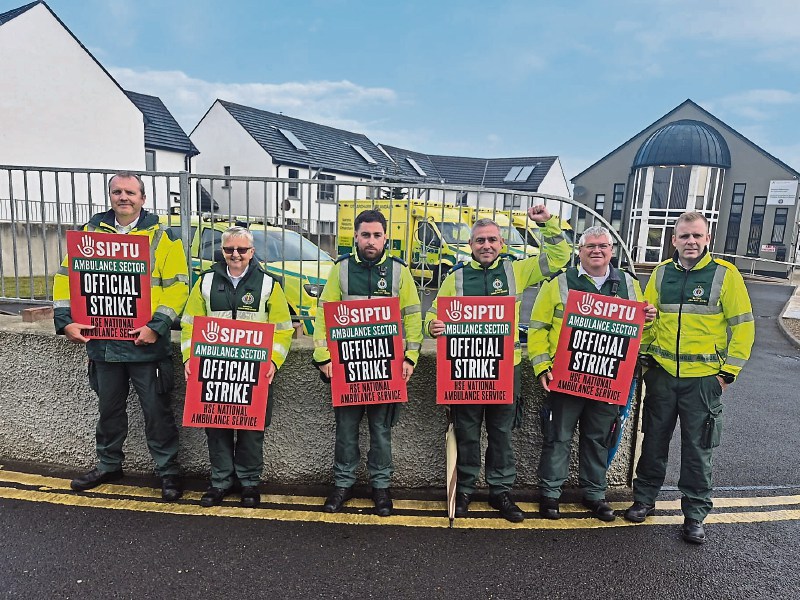
Staff picket at Dungloe ambulance base on Tuesday.